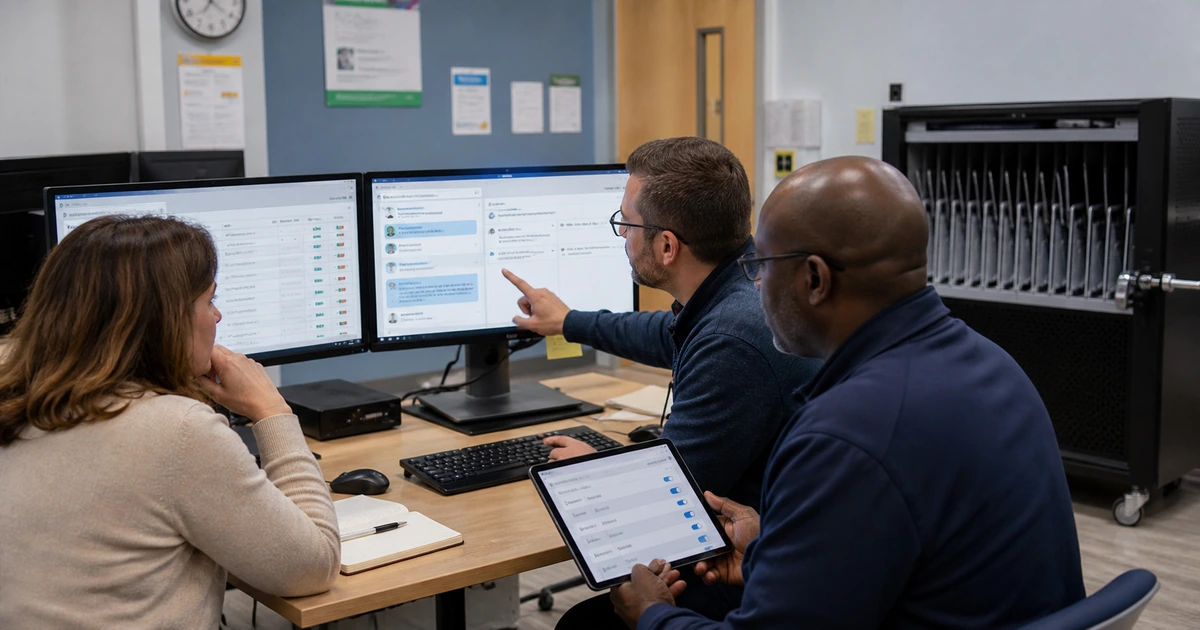
AI workflow automation should remove delay and repetitive effort without making employees or customers absorb the risk of an unfinished rollout. Disruption usually comes from changing too many parts at once, assuming a successful demonstration represents daily work, overlooking exceptions, or removing the manual process before the new path has earned trust. A controlled implementation keeps the business operating while evidence accumulates.
Treat the change as an operating-system rollout, not a prompt-writing exercise. Define the business result, map the complete workflow, protect required data, test integrations, assign human decisions, prepare support, and choose a pilot group that includes ordinary users and difficult cases. Keep the old process available long enough to compare results and recover work, but set a decision date so temporary duplication does not become permanent confusion.
ALLMSP implements AI workflow automation in house for Lawrenceville, Suwanee, Gwinnett County, Metro Atlanta, and organizations throughout Georgia. We can design the workflow, configure the platform, connect applications, secure access, train users, manage cutover, monitor production, and support the completed system from one accountable team.
Control the change before production work depends on it
- Protect critical work: Identify deadlines, customers, records, financial actions, and operations that cannot be interrupted or silently changed.
- Limit the first release: Choose one bounded workflow, a representative user group, defined data, and a small set of measurable outcomes.
- Prepare parallel operation: Decide which cases use the new path, which stay manual, and how results will be reconciled.
- Define rollback: Document who can stop the automation, how queued work is recovered, and how source records remain consistent.
- Train for exceptions: Teach employees how to verify results, recognize uncertainty, protect data, and obtain help.
- Stabilize before scaling: Resolve recurring failures, confirm support ownership, and meet acceptance measures before adding scope.
Prepare the workflow, people, and production boundary
Map the current work from trigger to completed business record. Include intake, validation, data retrieval, decisions, approvals, communication, updates to other systems, reporting, and exceptions. Measure current volume, completion time, waiting, corrections, and customer impact. Ask experienced employees to show the informal steps that keep the process working when information is missing or systems disagree. Those steps often determine whether the new automation will help or merely move the delay.
Define the first release in operational terms. State which users, request types, locations, systems, data classes, and actions are included. List what remains outside scope. Name the business owner, technical owner, data owner, security owner, support lead, and final acceptance authority. Publish a simple communication plan that explains what is changing, when it changes, how users verify results, where exceptions go, and how the team will respond when the automation is unavailable.
- Business baseline: Record present time, queue age, error, rework, cost, customer effect, and employee effort.
- Release boundary: Define users, cases, data, systems, actions, exclusions, dates, and approval authority.
- Critical calendar: Avoid payroll, billing, reporting, seasonal, regulatory, or customer deadlines when rollback time is limited.
- Support readiness: Prepare intake, triage, access, logs, runbooks, escalation, after-hours needs, and owner contacts.
- Stop conditions: Predefine security, accuracy, backlog, customer, financial, or availability thresholds that pause the rollout.
A narrow and explicit production boundary allows the team to learn from real work without putting the entire operation inside the experiment.
Pilot under real conditions with parallel checks and rollback
Choose pilot users for the work they encounter, not because they are friendly to the project. Include high-volume operators, mobile or remote users, employees with unusual permissions, customer-facing staff, and the people who handle incomplete or conflicting requests. Test ordinary cases first, then missing fields, duplicates, stale records, restricted data, unexpected formats, integration timeouts, model uncertainty, and requests the system should refuse. Record the expected outcome before each test.
Use parallel operation where consequences justify it. The automation can prepare, classify, or recommend while a qualified employee completes or verifies the official action. Compare both paths and investigate every material difference. Keep source-of-truth systems protected from duplicate updates. Test rollback by stopping the workflow, preserving queued items, restoring the prior route, completing urgent work, and reconciling records after service returns. A rollback plan that has never been exercised is only an assumption.
- Pilot evidence: Save input type, expected result, actual result, reviewer, correction, duration, version, and decision.
- Parallel rule: Specify which result is official, how duplicate action is prevented, and when comparison ends.
- Human authority: Give reviewers the context, skill, time, and permission to reject or correct automated output.
- Rollback test: Stop safely, recover work, restore the prior path, reconcile systems, and communicate status.
- Acceptance gate: Require agreed accuracy, timing, security, continuity, usability, cost, and support results.
The pilot is successful when production-like work can pass, exceptions are visible, and employees can recover without relying on the person who built the automation.
Stabilize the new operation before expanding automation
During the first production weeks, review the queue and exceptions every business day. Watch for skipped records, duplicate action, delayed approvals, failed connectors, expired credentials, excessive model cost, unsupported file types, permission changes, and employees quietly returning to personal workarounds. Measure time to a verified result and correction effort, not only the number of automation runs. A high run count can hide low business value or growing rework.
Close the temporary rollout state deliberately. Decide which manual records must be retained, when the old path becomes emergency-only, and how employees will know the authoritative process. Update documentation with actual screenshots or menu names only when they improve task accuracy, and keep the procedure tied to roles rather than one person. Schedule evaluation after platform releases, workflow changes, data-source changes, incidents, and material shifts in volume or business consequence.
- Daily stabilization: Review failures, backlog, corrections, user questions, customer impact, access, cost, and unresolved ownership.
- Trend review: Find repeated exception causes and correct the process, source data, rule, integration, or training.
- Documentation: Record normal work, exception routing, support evidence, approval, fallback, recovery, and reconciliation.
- Expansion decision: Add users or actions only when current scope meets acceptance measures and support remains healthy.
- Lifecycle control: Retest after relevant changes and retire unused flows, connections, credentials, data copies, and licenses.
Controlled stabilization turns a promising automation into a service the business can trust, support, and improve without unnecessary interruption.
End-to-end AI workflow implementation from ALLMSP
ALLMSP can manage the complete rollout, including current-state mapping, platform selection, licensing, configuration, integration, identity, data protection, evaluation, training, cutover, monitoring, and help desk support. We design rollback and manual continuity before production depends on the new workflow.
Businesses across Gwinnett County and Georgia can keep the full project with our internal team. That lets workflow decisions stay connected with managed IT, cybersecurity, Microsoft 365, Google Workspace, cloud systems, devices, and the employees who need support after launch.
- Prepare: Map work, establish measures, define ownership, protect data, and plan communication and support.
- Deploy: Configure, integrate, test, train, pilot, run in parallel, exercise rollback, and approve production.
- Support: Monitor queues and failures, help users, correct recurring causes, document changes, and scale carefully.
Primary resources for a controlled AI rollout
Use current risk, security, adoption, and automation guidance to support a phased release that fits the actual platform and business consequence.
- NIST AI Risk Management Framework. Provides lifecycle functions for governing, mapping, measuring, and managing AI risks before and after deployment.
- NIST Generative AI Profile. Highlights risks and actions that can inform evaluation, human oversight, incident handling, and continued monitoring.
- Microsoft Power Automate adoption guidance. Covers strategy, governance, lifecycle practices, maturity, and management for scaling automation in an organization.
- Microsoft Copilot rollout guidance. Recommends readiness work, a limited phased release, training, feedback, usage review, and controlled expansion.
AI workflow rollout FAQs
Limit the first release, keep a tested manual path, use parallel verification where consequences justify it, schedule around critical deadlines, define stop conditions, and expand only after production-like acceptance tests pass.
How can AI workflow automation be introduced without stopping normal work?
Include normal operators, high-volume users, people with unusual permissions or mobile needs, customer-facing employees, exception handlers, a qualified reviewer, and the eventual support owner.
Who belongs in an AI workflow pilot?
Record volume, queue age, completion time, wait time, error, correction effort, rework, customer impact, operating cost, and employee effort from an identified source and time period.
What should be measured before the rollout?
Use parallel operation when an incorrect result could affect customers, money, records, safety, access, or compliance, or when the new workflow has not yet produced enough representative evidence.
When should the old process run in parallel?
Name the stop authority, disable method, queued-work treatment, prior route, urgent manual procedure, communication path, source-record protection, recovery test, and reconciliation steps.
What belongs in an automation rollback plan?
Pause for material security or privacy exposure, duplicate or missing transactions, unacceptable accuracy, uncontrolled backlog, failed recovery, unexpected customer impact, or loss of qualified human review.
Which problems should automatically pause a rollout?
Continue daily review until volume, exceptions, support, cost, security, and business outcomes are consistently within acceptance limits. The duration depends on risk and process frequency rather than a fixed calendar.
How long should stabilization last?
Expand after current users and edge cases pass, recurring causes are corrected, support can handle demand, continuity is tested, owners accept residual risk, and the expected business result is visible.
When is it safe to expand the automation?
Can ALLMSP handle the complete rollout in house?
Yes. ALLMSP can design, configure, integrate, secure, test, train, deploy, monitor, troubleshoot, and improve the workflow with its own team.
Where does ALLMSP provide AI workflow automation services?
ALLMSP provides local service in Lawrenceville, Suwanee, Gwinnett County, and Metro Atlanta, plus implementation and remote support throughout Georgia.
Q. How long does it take to implement a workflow automation project?
A. Simple automations inside Microsoft 365 or a CRM can often be designed and deployed within weeks. More complex cross system integrations may take longer depending on scope and testing requirements.
Q. Is AI workflow automation expensive?
A. Many businesses already own tools like Microsoft 365 that include automation capabilities. The main investment is in planning, configuration, integration, and oversight. When targeted correctly, automation often delivers clear time and cost savings.
Q. How do we avoid disrupting daily operations during implementation?
A. Use a phased rollout, test in controlled environments, run parallel processes briefly, and provide focused user training. Careful planning minimizes risk and ensures smooth adoption.
Q. What is included in a workflow automation readiness review?
A. A readiness review typically evaluates current processes, systems, integration points, security considerations, and potential ROI. It results in a prioritized roadmap for safe and effective automation.
Q. What should a business inventory before implementing AI workflow automation?
A. Document the current process, owner, users, systems, data sources, permissions, handoffs, exceptions, approvals, customer impact, error rates, timing, and the manual work that should remain under human control.
Q. Which AI workflow automation metrics should leadership review?
A. Track cycle time, manual touches, error rate, exception volume, user adoption, customer response time, automation failures, security events, cost per transaction, hours returned to staff, and verified business outcomes.
Q. Can implementing AI workflow automation be completed in phases?
A. Yes. Start with one bounded, high-volume workflow, test with a small group, keep a rollback path, compare results with the original process, then expand after reliability and ownership are proven.
Q. What documentation should remain after implementing AI workflow automation?
A. Maintain the process map, data sources, prompts or rules, system connections, access permissions, approval points, exception handling, owners, monitoring, rollback steps, test evidence, and change history.
How ALLMSP Helps Georgia Businesses Implement AI Workflow Automation
Workflow automation is not just about turning on features inside existing software. It requires structured process mapping, smart tool selection, secure integration, and ongoing optimization.
ALLMSP works with Georgia businesses to:
- Conduct workflow automation readiness reviews
- Map and document current state processes
- Identify high ROI automation opportunities
- Design automation using Microsoft 365, CRM, accounting, and other core systems
- Integrate platforms securely and reliably
- Train teams and support adoption
- Monitor and refine workflows over time
The result is measurable improvement without operational chaos.
If your team is buried in manual tasks but unsure where to begin, a structured automation roadmap can turn scattered ideas into a focused plan with clear outcomes.