You need a new IT vendor. Maybe your current provider is slow to respond. Maybe you are expanding offices, moving to Microsoft 365, replacing a VoIP system, or signing your first managed IT services contract. The pressure builds quickly. A referral comes in. A proposal looks affordable. A contract arrives with pages of technical language. And too often, the decision is made based on price, urgency, or familiarity rather than a structured evaluation process. That is how businesses end up under-scoped, overcharged, or locked into long-term agreements that do not align with their operational needs.
Step 1: Define Your Business Requirements Before You Talk to Vendors
The biggest mistake leaders make is letting vendors define the problem for them.
Before requesting proposals for managed IT services, cloud platforms, VoIP systems, cybersecurity tools, or structured cabling, document your internal requirements.
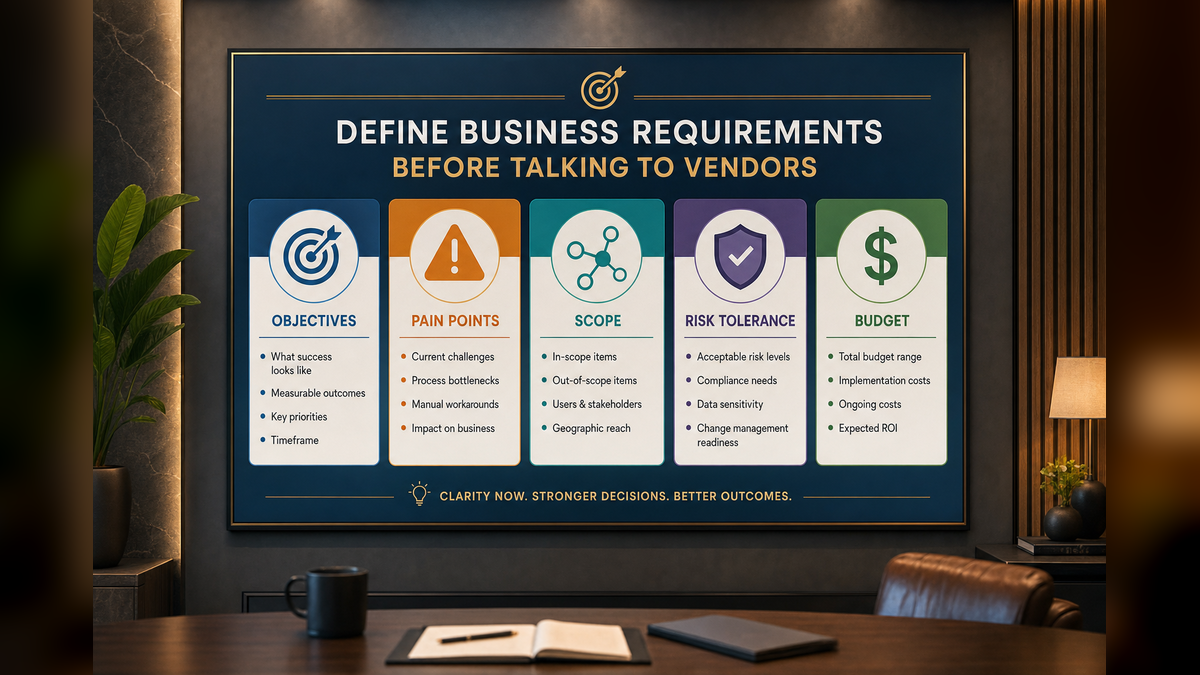
Clarify These Five Areas First
- Business objectives
Are you trying to improve response time, support growth, reduce downtime, improve security, or simplify vendor management? - Current pain points
Slow help desk response? Confusing escalation? Poor documentation? Unclear billing? - Scope of coverage
How many users, locations, devices, remote workers, and critical systems are involved? - Risk tolerance
What level of downtime is acceptable? How quickly must issues be resolved? - Budget range
Not just monthly fees, but onboarding, hardware, licensing, and future growth.
Write this down in plain business language. This document becomes your evaluation baseline. Every vendor proposal should be compared against it.
Step 2: Compare Scope, Not Just Price
Two IT proposals may look similar on the surface. Both promise support, security, and monitoring. One is significantly cheaper.
But what is actually included?
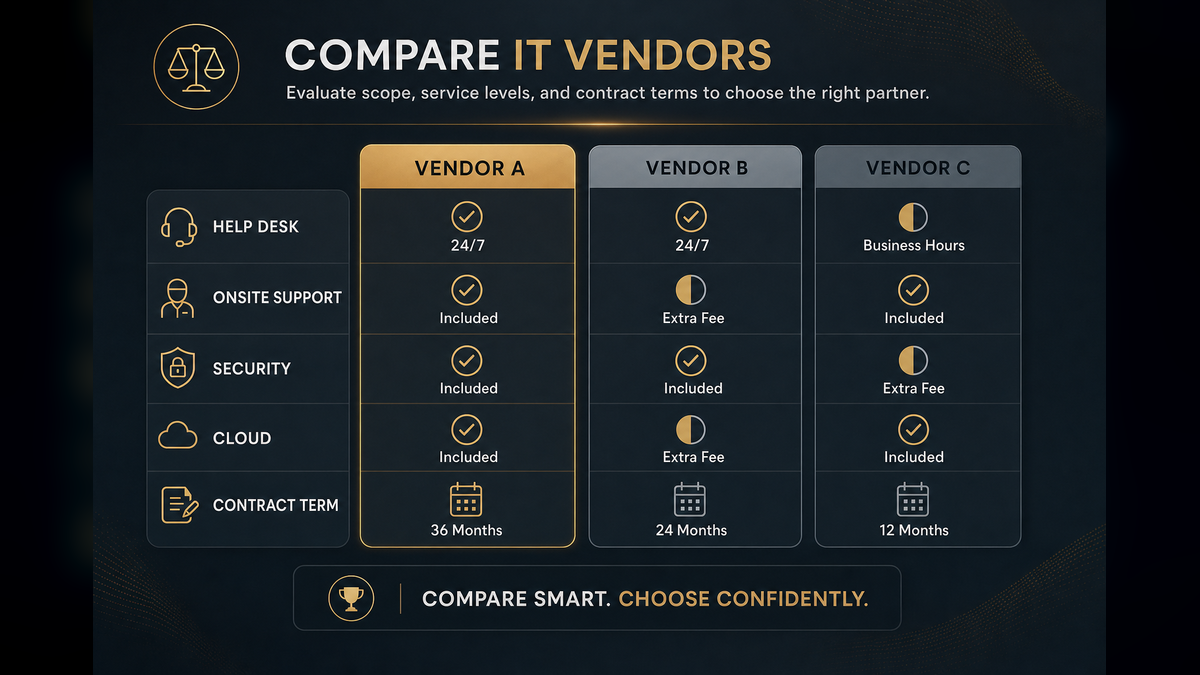
Create a Side-by-Side Comparison Table
| Category | Vendor A | Vendor B | Vendor C |
|---|---|---|---|
| Help desk hours | 8 to 5 weekdays | 24/7 | 8 to 6 weekdays |
| Onsite support | Billable | Included | Limited hours |
| Cybersecurity tools | Basic endpoint | Endpoint + email security | Endpoint only |
| Cloud management | Extra fee | Included | Included |
| Contract term | 36 months | 12 months | 24 months |
When reviewing managed IT services contracts and service level agreements, look closely at:
- Guaranteed response times versus best effort language
- Escalation procedures
- After-hours support fees
- Project work billing rates
- Hardware lifecycle planning
- Cloud licensing markups
A lower monthly price often means narrower scope. That may be fine, but only if it matches your documented requirements.
Step 3: Evaluate Operational Maturity and Support Workflows
Technology tools matter. But process maturity matters more.
Ask vendors to walk you through how they actually deliver service.
Questions That Reveal Capability
- How are tickets prioritized and escalated?
- What does your help desk response workflow look like?
- Who owns documentation of our environment?
- How do you handle vendor coordination with cloud or software providers?
- What happens if a primary technician is unavailable?
For example, if you are selecting a VoIP or unified communications provider, ask how outages are detected and communicated. If you are evaluating a cloud platform such as Microsoft 365 or Google Workspace, ask who manages configuration, licensing changes, and security policies.
Strong vendors can clearly explain their onboarding process, documentation standards, monitoring tools, and escalation paths.
If answers are vague, that is a risk signal.
Step 4: Assess Risk, Contracts, and Exit Strategy
IT vendor decisions often last years. Contracts should be reviewed as carefully as capabilities.
Contract Areas to Review Carefully
- Term length and auto-renewal clauses
- Termination rights and notice periods
- Ownership of documentation and credentials
- Data access and backup responsibilities
- Transition support if you change vendors
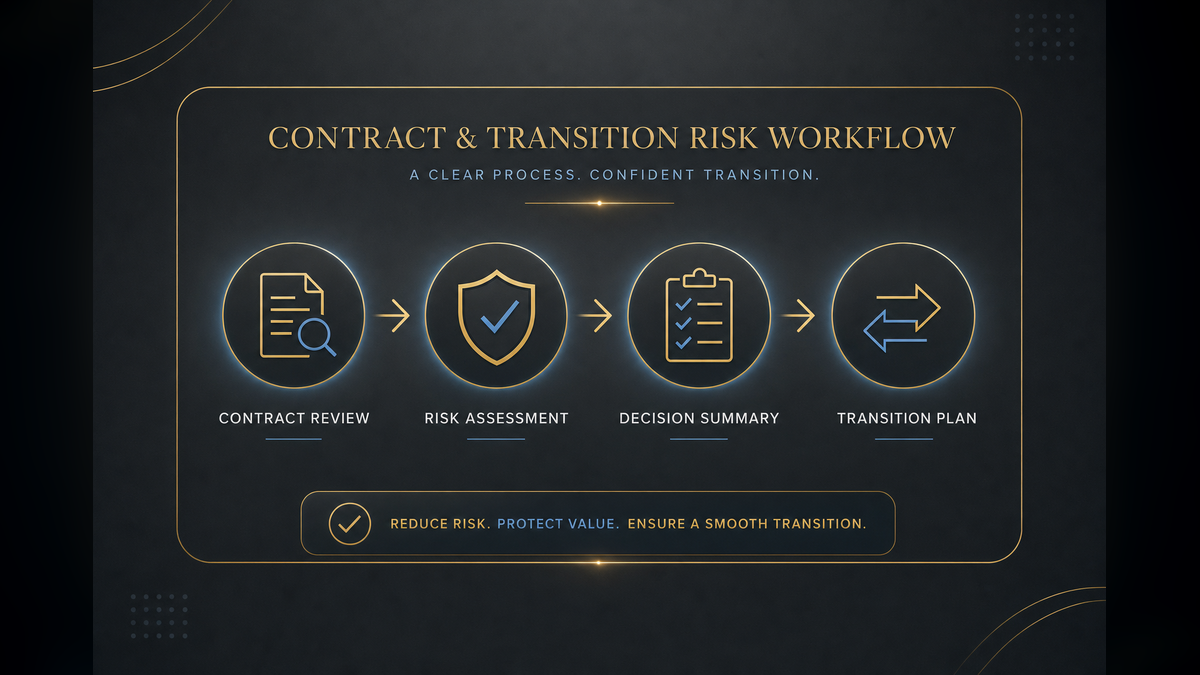
If you are switching providers, require a written transition plan. This should include:
- Knowledge transfer timeline
- Administrative credential handoff
- Asset inventory validation
- Vendor onboarding milestones
Whether you are selecting an ERP system, practice management software, endpoint protection platform, or structured cabling provider for an office expansion, always ask: what happens if this does not work out?
A good vendor is confident enough to define a clean exit process.
Step 5: Make a Defensible Executive Decision
Once proposals are reviewed, bring the evaluation back to business leadership.
Create a short summary document that includes:
- Your original business requirements
- Side-by-side comparison highlights
- Risk considerations
- Total estimated cost over the contract term
- Strengths and tradeoffs of each option
This protects decision makers. It demonstrates due diligence. And it shifts the conversation from price alone to value, risk, and operational fit.
The right IT vendor is not the cheapest. It is the one whose services, processes, and contract terms align with your organization’s long-term goals.
Frequently Asked Questions
Q. How many IT vendors should we compare?
A. Three is typically a practical number. Fewer than that limits perspective. More than that can overwhelm decision makers and slow the process without adding clarity.
Q. Should we always choose a local Georgia IT vendor?
A. Local presence can be valuable for onsite support and relationship management. However, process maturity, responsiveness, and scope alignment are more important than geography alone.
Q. What is the biggest mistake businesses make when signing IT contracts?
A. Failing to understand what is excluded. Many issues arise not from what is promised, but from assumptions about services that were never included in the agreement.
Q. How long should an IT services contract last?
A. Contract length should reflect your comfort with the provider, the complexity of onboarding, and the investment required. Shorter initial terms can reduce risk while the relationship is proven.
Q. Can ALLMSP replace an underperforming IT provider without disrupting operations?
A. Yes. ALLMSP can assess the environment, document responsibilities, plan credential and knowledge transfer, validate backups and security, communicate with users, and complete the managed IT transition in house.
Q. What should be included in an IT vendor transition plan?
A. A clear timeline, documentation transfer, credential handoff, asset verification, and defined responsibilities between outgoing and incoming providers.
Q. What should a business inventory before evaluating and transitioning an IT provider?
A. Document current services, assets, systems, locations, users, risks, contracts, renewal dates, response expectations, project needs, ownership gaps, credentials, and the business outcomes a provider must support.
Q. Which IT provider selection metrics should leadership review?
A. Compare response and resolution time, recurring incidents, project completion, documentation quality, security coverage, roadmap progress, user satisfaction, budget accuracy, escalation quality, and unresolved responsibility gaps.
Q. Can evaluating and transitioning an IT provider be completed in phases?
A. Yes. Requirements and risk can be documented first, followed by proposal comparison, contract review, transition planning, credential transfer, system validation, and a controlled support handoff.
Q. What documentation should remain after evaluating and transitioning an IT provider?
A. Retain the approved scope, service responsibilities, exclusions, response targets, escalation contacts, pricing assumptions, asset records, credentials handoff, transition plan, acceptance checks, and renewal dates.
How ALLMSP Helps Businesses Evaluate and Select IT Vendors
Vendor selection is one of the most important IT consultation functions we provide at ALLMSP.
We act as an independent advisor, technical translator, and risk evaluator before contracts are signed.
Our role may include:
- Helping you define business and technical requirements
- Reviewing managed IT services contracts and service level agreements
- Sitting in on vendor meetings to ask the right operational questions
- Translating technical language into business risk and cost implications
- Comparing cloud, VoIP, cybersecurity, and software proposals side by side
- Advising on onboarding and transition planning during an IT switch
Sometimes we become the long-term provider. Other times, we simply ensure you make a confident, well-informed decision with another vendor.
Either way, the goal is the same: fewer disruptions, cleaner handoffs, better visibility into cost, and alignment between technology and business strategy.