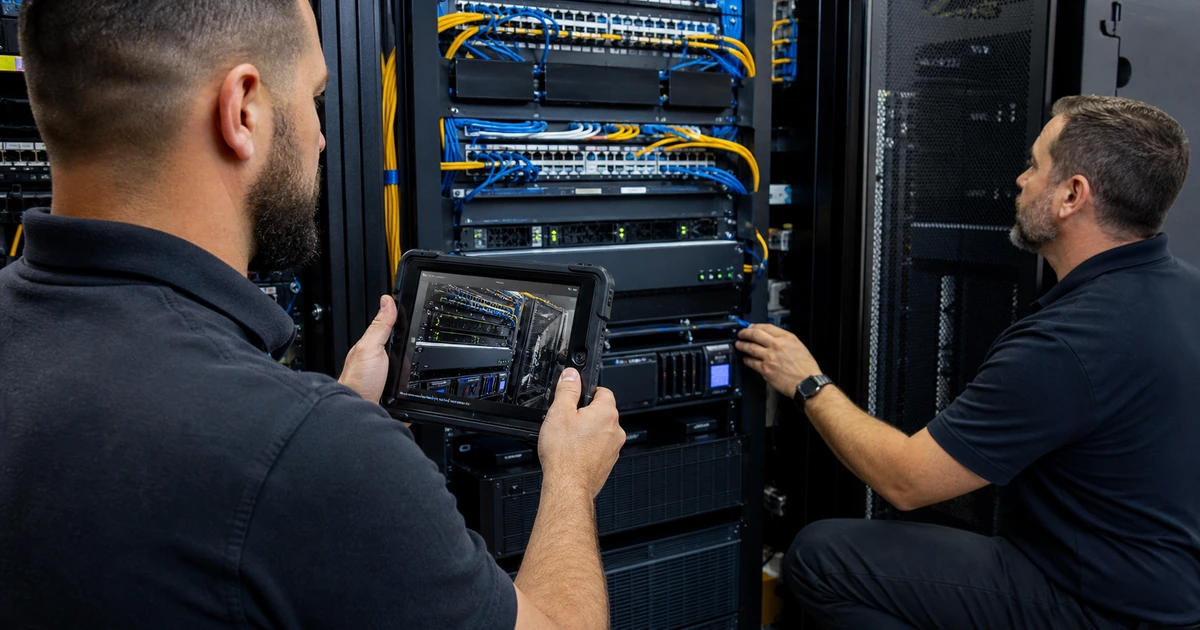
























































































































































A monitoring audit asks whether the organization would see and act on the failures that matter. A platform can display hundreds of green devices while missing an acquired site, a cloud network, a backup circuit, an expiring certificate, an unsupported firewall, or the notification path itself. The audit must compare reported coverage with independent evidence and test the full route from condition to recovery.
Review strategy, inventory, collectors, credentials, telemetry, baselines, thresholds, dependencies, maintenance, notifications, tickets, runbooks, escalation, dashboards, retention, and recovery. Sample real assets and incidents. Examine whether administrators can make unreviewed changes, whether logs support investigation, and whether customer and business contacts know what will happen during a serious event.
ALLMSP conducts network monitoring audits for businesses in Lawrenceville, Suwanee, Gwinnett County, Metro Atlanta, and across Georgia. Our in-house team reconciles infrastructure, tests signals and alert routes, reviews operational and security controls, identifies blind spots, and implements prioritized corrections.
Test the complete monitoring system from asset to business outcome
- Verify scope: Compare monitored assets and services with network, cloud, carrier, security, purchasing, and site evidence.
- Sample telemetry: Check reachability, performance, hardware, configuration, security, logs, timestamps, and missing-data behavior.
- Review alerts: Measure actionability, severity, dependencies, maintenance, repetition, missed incidents, and user-reported-first failures.
- Test escalation: Exercise delivery, acknowledgment, after-hours response, business communication, product support, carrier, and dispatch.
- Secure the platform: Inspect roles, multifactor authentication, integrations, collectors, secrets, change logs, exports, backup, and retention.
- Assign correction: Rank blind spots and control failures by service impact, exposure, recurrence, recovery, and accountable due date.
Reconcile coverage and verify that telemetry tells the truth
Build an independent population from firewall, switch, wireless, server, virtualization, cloud, DNS, certificate, VPN, voice, camera, access-control, circuit, support, purchasing, and physical-site records. Compare it with monitored objects. Investigate missing, duplicate, stale, unknown, retired, unsupported, and separately managed technology. Confirm that every important business service has external and internal evidence where appropriate, and that shared dependencies such as power, carrier, authentication, DNS, cloud gateways, and monitoring collectors are visible.
Select high-risk and random assets for direct validation. Compare device state with the monitoring record for interfaces, routes, tunnels, errors, utilization, latency, loss, resources, wireless, hardware, certificates, configuration, security events, and log timestamps. Trigger safe test conditions or use vendor-supported simulations. Verify that data stops and creates a fault when collection is interrupted. Check clock accuracy and retention because stale or misaligned timestamps can defeat incident reconstruction even when dashboards look current.
- Population variance: List active technology absent from monitoring and monitored objects without a current owner, service, or asset.
- Service coverage: Confirm internal, external, dependency, redundancy, security, and user-experience evidence for priority functions.
- Data comparison: Match direct device or service readings with collected values, state, timestamp, units, and expected refresh.
- Silence behavior: Disconnect a safe source or collector path and confirm missing telemetry creates a visible actionable condition.
- Lifecycle gap: Find unsupported, replaced, moved, renamed, newly acquired, cloud-created, or retired systems with incorrect status.
The audit establishes confidence by proving that the platform sees the current environment and represents device and service state accurately.
Measure alert quality and rehearse every escalation path
Review alert and incident history by severity, source, service, site, time, owner, action, and outcome. Calculate alerts that created tickets, received acknowledgment, required remediation, repeated without root-cause work, or closed automatically. Identify outages and user complaints that monitoring missed or detected late. Inspect dependency grouping, recovery thresholds, maintenance windows, notification content, and runbook links. A high volume is not proof of strong coverage, and a quiet month is not proof of reliability.
Test notification and escalation with controlled cases. Verify primary and backup channels, ticket creation, acknowledgment, paging, after-hours response, failed-delivery handling, management notification, customer contact, carrier escalation, manufacturer support, and on-site access. Give the responder only the information the alert normally provides and observe whether the service map, credentials route, runbook, authority, and contacts are sufficient. Record elapsed time and every manual workaround needed to reach the right decision.
- Actionability rate: Separate alerts that drove useful work from symptoms, duplicates, informational trends, and unactionable noise.
- Missed detection: Match outages, security events, user tickets, and carrier cases against monitoring timelines and available signals.
- Message quality: Check asset, service, impact, evidence, duration, dependency, runbook, owner, and next escalation time.
- After-hours proof: Exercise paging, acknowledgment, backup contact, business authority, communication, carrier, and dispatch.
- Runbook outcome: Confirm a responder can diagnose, act safely, communicate, recover, validate, and document from current instructions.
Escalation is reliable only when a realistic test reaches the right responder and produces a controlled, timely action.
Review platform security, recovery, and corrective governance
Inspect local and cloud administrative access, service accounts, collectors, application integrations, webhooks, notification gateways, remote actions, stored device credentials, exports, and support access. Require named accounts, least privilege, multifactor authentication where supported, secure secrets, restricted collector paths, logging, and regular access review. Examine who can disable checks, change thresholds, suppress alerts, alter retention, delete history, or run commands. Important configuration changes should have an owner and a reason.
Verify configuration backup, collector recovery, license continuity, vendor contact, notification alternatives, documentation export, retention, and migration options. Then create a correction register with finding, evidence, affected service, security or operational consequence, root cause, action, owner, due date, dependency, interim protection, and retest. Prioritize missing critical services, failed alert delivery, broad administrative access, unsupported platforms, invisible collectors, recurring missed incidents, and recovery procedures that cannot meet business needs.
- Administrative control: Review roles, identities, multifactor protection, secrets, actions, integrations, support access, and audit records.
- Change governance: Trace threshold, check, maintenance, dashboard, routing, retention, and deletion changes to approval and purpose.
- Platform recovery: Test configuration backup, collector rebuild, credentials recovery, notification failover, licensing, and documentation access.
- Finding priority: Combine business service, exposure, blind-spot duration, recurrence, affected population, and recovery weakness.
- Closure evidence: Retest the corrected asset, signal, notification, response, user outcome, security control, and documentation.
An audit is valuable when it leaves a protected monitoring platform and a short owned correction plan, not a static list of observations.
Network monitoring audits and remediation from ALLMSP
ALLMSP can reconcile monitored coverage with current network, cloud, security, carrier, support, and site evidence. We sample telemetry, test missing-data behavior, analyze alert history, rehearse escalation, and review platform access and recovery.
Our in-house technicians can also implement the corrections, including discovery, collector repair, credential hardening, new service checks, threshold tuning, notification changes, runbook updates, and recovery testing. Each material finding receives an owner and retest evidence.
- Prove: Validate population, service coverage, telemetry accuracy, data freshness, alert delivery, and response.
- Protect: Harden administrators, collectors, secrets, integrations, change records, retention, and recovery.
- Correct: Prioritize blind spots, implement fixes, assign ownership, and verify operational and business outcomes.
Authoritative references for monitoring assessment
An assessment should evaluate both the completeness of monitoring and whether strategy, procedures, operations, and analysis support timely risk decisions.
- NIST monitoring program assessment. Provides evaluation criteria for strategy, policy, procedures, operations, completeness, and analysis of continuous monitoring.
- NIST continuous monitoring guidance. Describes organizational visibility, risk alignment, control effectiveness, and timely response expectations.
- NIST log management guidance. Supports review of how event data is generated, transmitted, stored, accessed, analyzed, retained, and disposed.
- ALLMSP cybersecurity services. Connects network visibility with threat detection, vulnerability management, identity, endpoint security, and incident response.
Network monitoring audit FAQs
What does a network monitoring audit examine?
It reviews scope, telemetry, dependencies, baselines, alerts, maintenance, delivery, escalation, access, logs, retention, recovery, documentation, and outcomes.
How can monitoring coverage be independently verified?
Compare monitored objects with device configurations, cloud resources, security tools, circuits, purchasing, support records, and physical inspection.
Why should telemetry be sampled directly?
Direct comparison reveals stale data, wrong units, bad templates, polling failures, duplicate identities, incorrect thresholds, and misleading status.
What does a monitoring blind spot look like?
It can be an unmonitored service, missing dependency, stale collector, unknown asset, failed notification, unsupported device, or signal that never reaches action.
How is alert noise measured?
Review repetition, dependent symptoms, auto-closures, tickets, acknowledgment, remediation, user impact, missed incidents, and alerts that produced no decision.
Should an audit test after-hours contacts?
Yes. A controlled test should verify delivery, acknowledgment, backup contacts, authority, communication, vendor escalation, and dispatch.
Why must the monitoring platform itself be secured?
It may hold infrastructure data, credentials, logs, remote actions, integrations, and the ability to suppress evidence or change alerts.
What recovery tests apply to monitoring?
Test configuration backup, collector rebuild, credential recovery, alternative notifications, license continuity, data retention, and access to documentation.
Can ALLMSP fix issues found in the audit?
Yes. ALLMSP can implement discovery, telemetry, access, alert, escalation, documentation, platform, and recovery corrections in house.
Where can ALLMSP perform a network monitoring assessment?
ALLMSP audits network monitoring for organizations in Lawrenceville and Suwanee, including multi-site environments across Gwinnett County, Metro Atlanta, and Georgia.