



















































































































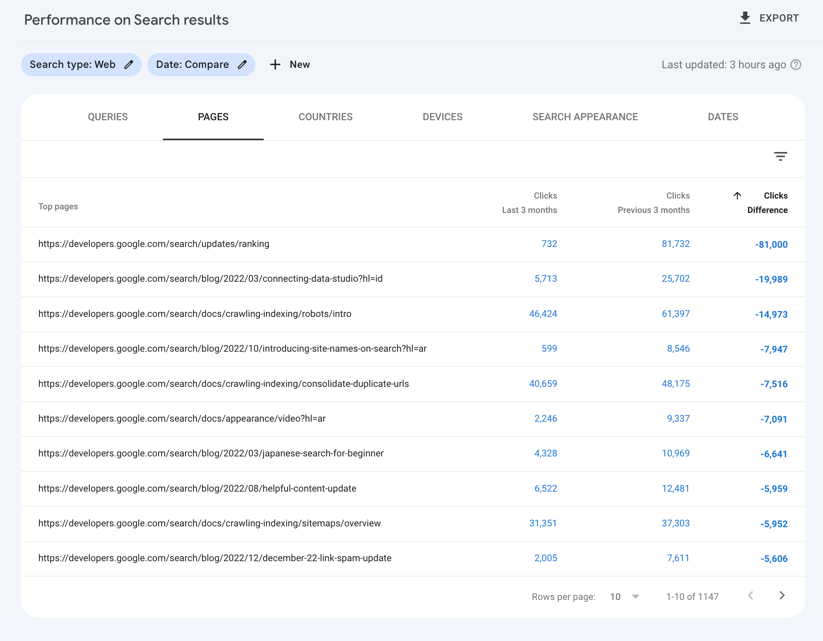
Google’s Search Console example compares clicks for individual pages across two periods. Check which service pages and queries actually match the work your firm accepts, with comparable filters and dates. These Google sample figures do not measure consultations, retained matters or results for a law firm.[6]
Law firm local marketing improves when search visibility, public accuracy, intake quality, and retained matters are reviewed together. More impressions do not help if pages attract matters the firm does not accept, location claims are inaccurate, calls go unanswered, forms collect unsafe detail, or reporting stops before conflict and qualification.
Do not optimize by repeating city names, manufacturing reviews, hiding disclosures, exaggerating results, or creating pages for offices and services that do not exist. Confirm current professional rules and obtain attorney approval for material public communications before changing claims or promotion.
Use the current official Georgia rules for attorney review of confidentiality and communications; the firm determines their application. [1]
How to choose the right law firm marketing system improvements
A useful optimization program increases qualified visibility for approved services and real service areas, improves trustworthy page content and profile accuracy, reduces irrelevant paid demand, shortens intake response, and connects marketing effort to consultation and retained-matter evidence.
- Pages earn impressions for services, jurisdictions, or locations the firm does not handle.
- Titles and ads promise results or distinctions that are not supported by the visible page and approval record.
- Several city pages repeat the same copy without useful office, process, service-area, or client information.
- Business Profile calls, forms, and Ads conversions are counted without conflict, qualification, consultation, or retention status.
- Prospective clients wait too long, submit urgent facts into a generic form, or never receive documented non-engagement handling.
- Content is rewritten for rankings without an attorney review, source record, user need, or outcome measure.
Find qualified local demand and public-information gaps
Relevant impressions with weak clicks
Diagnosis: Use Search Console by page and query, then inspect the visible result, competing pages, title, description, service fit, location, position, and device. Confirm the page actually answers the query before changing the snippet.
Search Console measures search visibility and clicks; it does not establish consultation or engagement outcomes. [3]
Law Firms Marketing improvement: State the approved service and realistic location clearly, improve the page’s useful explanation and proof, and revise the title and description without unsupported promises.
Measurement: Track qualified query clicks, click-through rate within similar positions, valid inquiries, and retained matters for the same page group.
Duplicate or thin location pages
Diagnosis: Compare city and office pages for unique facts, service availability, attorneys, process, directions, local resources, intake route, internal links, and real search demand. Identify unsupported office language and interchangeable text.
Law Firms Marketing improvement: Consolidate overlap or create a genuinely useful page for a real office or service-area need. Explain how Lawrenceville, Suwanee, Gwinnett, Atlanta, or another market is served accurately.
Measurement: Track qualified local clicks, accepted inquiries by actual location, duplicate-page switching, engagement, and retained matters.
Google Business Profile inconsistency
Diagnosis: Review ownership, primary category, services, hours, phone, website, office eligibility, duplicates, practitioner profiles, photos, posts, questions, reviews, and suspension or edit alerts. Compare with the website and intake.
Law Firms Marketing improvement: Correct inaccurate information, close or merge improper duplicates through supported processes, assign review response, and keep a change record and backup owner.
Apply Google’s actual business and practitioner eligibility rules and represent the real operation accurately. [2]
Measurement: Track profile actions, connected calls, valid inquiries, edit rejections, duplicate resolution, review response, and ownership tests.
Improve pages, profiles, campaigns, and intake
Public claims lack current review
Diagnosis: Inventory results, testimonials, awards, rankings, specialties, comparisons, fee statements, office locations, attorney biographies, and paid content. Locate approval, support, date, and required disclosure.
Law Firms Marketing improvement: Obtain accountable attorney review, correct or remove unsupported language, add approved disclosures, and schedule rechecks after personnel, rules, or service changes.
Measurement: Track reviewed assets, expired support, corrections completed, approval time, and recurring claim categories.
Paid search attracts the wrong matters
Diagnosis: Review search terms, locations, schedules, devices, ads, landing pages, calls, forms, conflicts, qualification, and retained outcomes. Separate research, jobs, existing clients, unsupported services, and out-of-area demand.
Law Firms Marketing improvement: Add precise negatives, tighten approved service themes and geography, align pages and claims, adjust schedule to intake coverage, and optimize toward qualified outcomes rather than every call.
Google distinguishes initial inquiries from qualified and converted lead stages. Any advertising upload requires a separate approved data/consent and implementation decision. [5]
Measurement: Track irrelevant spend, cost per qualified consultation, retained matters, intake response, and spend by accepted service and location.
Forms collect too much sensitive detail
Diagnosis: Review fields, free text, file upload, URL parameters, analytics payloads, email notifications, storage, access, retention, mobile use, warnings, and conflict routing. Test what reaches Google and outside vendors.
Law Firms Marketing improvement: Collect only routing information, keep confidential narrative and identity out of analytics, secure the intake destination, clarify urgent and representation boundaries, and limit access and retention.
Google’s ordinary Analytics collection must exclude personally identifiable information; inspect actual URLs and event data. [4]
Measurement: Track form completion, unsafe-data findings, routing accuracy, unauthorized access, spam, and valid inquiries.
Calls are measured without intake outcomes
Diagnosis: Compare phone clicks, connected calls, duration, missed calls, recordings where permitted, after-hours routing, intake classification, conflicts, consultations, and retained matters. Identify numbers owned by a provider.
Law Firms Marketing improvement: Keep phone numbers under firm control, improve routing and coverage, define qualified call outcomes, document recording decisions, and connect approved status back to reporting.
Measurement: Track connected and qualified calls, missed calls, response time, consultations held, retained matters, and number ownership.
Connect tracking to consultation and retained matters
Slow or inconsistent intake response
Diagnosis: Measure first useful response by source, service, day, time, urgency, and owner. Review failed notifications, duplicate follow-up, unanswered voicemail, scheduling, conflicts, non-engagement, and leave coverage.
Law Firms Marketing improvement: Set accountable routing and response expectations, create backup coverage, standardize status and notes, and monitor urgent or time-sensitive paths without making legal promises through automation.
Measurement: Track response time, contact rate, consultations scheduled and held, non-engagement completion, and qualified leads lost to delay.
Reporting stops at leads
Diagnosis: Map source, service, location, valid inquiry, conflict result, qualification, consultation, retention, decline reason, and approved value category. Identify platform conversions that cannot be reconciled with intake.
Law Firms Marketing improvement: Use non-sensitive identifiers and outcome categories to connect reporting, keep legal facts out of marketing platforms, reconcile records, and report retained matters alongside lead counts.
Measurement: Track record reconciliation, qualified consultation rate, retained matter rate, cost per retained matter, and unknown source.
Content changes have no maintenance owner
Diagnosis: Find pages without a responsible attorney, source record, last review, next review, current author or reviewer, change history, and search or intake purpose. Identify stale rules, people, offices, and claims.
Law Firms Marketing improvement: Assign legal and editorial owners, classify review frequency, update useful sections, archive prior versions, correct internal links, and retire content only after traffic and record implications are understood.
Measurement: Track pages reviewed on time, corrections, stale facts found, qualified demand after updates, and content retired or consolidated responsibly.
Measure useful visibility and maintain reviewed content
Review local visibility with attorneys and intake, not only marketing. Each monthly decision should name the user need, public claim, page or campaign, lead-quality evidence, confidentiality boundary, action, owner, and later result. Preserve approved versions so the firm can explain what was published and why.
- Qualified local visibility: Clicks and inquiries from approved services and real service areas, separated from unsupported matters, jobs, and existing-client demand.
- Advertising review coverage: Material public communications with current support, responsible-attorney approval, required disclosure decisions, and archived versions.
- Intake response: Time to first useful response, connected-call rate, routing failures, consultation scheduling, and urgent-path handling.
- Consultation quality: Valid inquiries that clear the firm’s intake criteria and reach a scheduled and held consultation.
- Retained-matter attribution: Approved non-sensitive linkage from source and service interest through retained outcome and value category.
- Local information accuracy: Website, Business Profile, directories, phone, hours, office or service-area claims, and attorney information matching current operations.
Separate a visibility problem from an intake problem
Illustrative diagnosis using the firm’s own approved data. No row promises rankings or retained matters.
On a narrow screen, scroll horizontally to read every table column.
| Observed pattern | Check before changing the page | Useful next decision |
|---|---|---|
| Search clicks rise but most inquiries are for an unsupported service | Compare query themes, page service scope and intake decline reasons. | Clarify the accepted service and correct campaign targeting; do not celebrate the raw lead increase. |
| Relevant clicks arrive but calls go unanswered | Test the published number, routing and staffed coverage. | Repair the response path before buying more traffic. |
| Consultations are recorded but the source is often unknown | Reconcile a restricted sample using approved references without legal narrative. | Fix the source/status handoff; do not infer retained matters from Analytics totals. |
Frequently Asked Questions
How can a law firm improve relevant Search Console impressions that do not earn clicks?
First check whether the queries actually match work the firm accepts. In Search Console, compare the same page, device and query group across similar periods and positions. If the service fits, improve the page’s direct answer, accurate title and next step. A lower click-through rate at a different position or for an unsuitable query is not proof that the page needs a more aggressive promise.
Supporting sources: [3]
Should a law firm create a separate page for every nearby city?
No. Publish a separate city page only when it answers a distinct, real service or office need. Explain the actual location relationship, relevant service process and appropriate intake route. Do not invent an office or repeat the same page with a different city name. Where pages serve the same need, evaluate consolidation and redirects while preserving useful search and user paths.
What should law firms optimize in Google Business Profile?
Start with eligibility and accurate public facts: real location, business name, category, hours, telephone and linked page. A mailing address or virtual office does not automatically qualify. Practitioner listings have their own Google conditions, so review the actual office arrangement before creating or merging profiles. Keep firm-controlled ownership and test that calls reach the intended intake team.
Supporting sources: [2]
Which law firm marketing claims need recurring review?
Recheck results, testimonials, awards, comparisons, specialties, fees and location statements whenever their support or context changes. Archive the claim, its evidence and the responsible attorney’s approval. Georgia’s current Rules 7.1 and 7.2 are the official starting point for communications about legal services; the firm must determine how the rules apply to each particular communication.
Supporting sources: [1]
How can law firms reduce irrelevant Google Ads inquiries?
Compare actual search terms and locations with the firm’s accepted services and intake results. Exclude irrelevant demand carefully, align each ad with the right reviewed page and fix missed-call coverage before increasing spend. Keep an initial inquiry distinct from a qualified consultation or retained matter. Any later Ads feedback needs its own privacy and implementation review; do not upload case narratives.
Supporting sources: [5]
How can a law firm improve contact forms without collecting unsafe data?
Ask only what the firm needs to route the inquiry, then move any required documents or detailed narrative into the approved intake process. Test the confirmation URL, page title, event parameters, notifications and third-party tools for exposed names or case facts. Google Analytics redaction is a backup control, not permission to send sensitive information and hope it disappears.
Supporting sources: [4]
Which law firm phone calls should count as marketing conversions?
Define separate stages for a telephone click, connected call and qualified inquiry. A long call can still be a wrong number or existing-client request, while a short call may arrange a valid consultation. Reconcile a sample with intake without placing legal facts in marketing reports. Recording, consent, retention and access decisions require the firm’s approved process.
How quickly should a law firm respond to a prospective-client inquiry?
There is no single response deadline that fits every firm or matter. Set a staffed first-response target from actual intake capacity and the services offered, with a separate urgent route and backup coverage. State when the channel is monitored and avoid implying representation or accepting a legal deadline through an automated message. Review missed calls and leads lost before useful contact.
How can law firms measure marketing through retained matters?
Keep the detailed matter record inside the approved legal system. Use an approved non-sensitive reference to reconcile source, valid inquiry, consultation and retained outcome in restricted reporting. Report unmatched records and declined or duplicate inquiries separately. This is a measurement workflow, not a reason to send client identities, conflict findings or confidential legal facts to advertising platforms.
How should a law firm maintain legal marketing content over time?
Give each material page a responsible attorney or qualified reviewer, an editorial owner and a review trigger. Recheck promptly after changes to lawyers, services, offices, fees, rules or supported claims; set a regular review interval for the rest. Keep the previous approved version and test the internal links and intake route after an update.
Choose the next step
- Audit Law Firm Marketing Claims, Tracking, and Intake Ownership — Audit ownership, claims and tracking when a useful page still loses inquiries.
- Connect Law Firm Search, Intake, and Retained Matters — Define the search-to-intake measurement path before judging retained-matter results.
Sources
- State Bar of Georgia: Georgia Rules of Professional Conduct. Current official Georgia rulebook to review confidentiality, supervision and communications about legal services; attorney determines application. ↩
- Google Business Profile: Guidelines for representing your business. Accurate real-world location/name/categories, office eligibility, practitioner specifics and business-controlled telephone; service-city pages do not create eligible offices. ↩
- Search Console: Performance report overview and basic setup. Clicks/impressions/CTR/position with query/page/device/date filters describe search performance, not consultations or signed clients. ↩
- Google Analytics: Best practices to avoid sending personally identifiable information. Avoid PII in ordinary Analytics collection including URLs, page titles and event data; redaction is not a replacement for preventing collection. ↩
- Google Ads: About qualified leads and converted leads. Qualified and converted lead milestones can represent defined later lead stages; privacy/consent/implementation eligibility must be checked separately before any upload. ↩
- Google Search Central technical documentation: debugging drops in search traffic ↩