
















































































































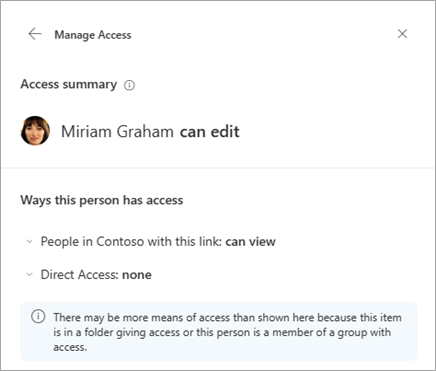
Microsoft’s published SharePoint example shows a sample person who can edit and warns that folder or group membership may provide additional access. The small native screenshot illustrates why a room review must check more than one invitation. It does not establish legal ownership, approval or the permissions of a live deal room.[6] View full-size image
A private equity security review should collect current evidence from identities, rooms, fund systems, financial workflows, advisers, devices, providers, portfolio connections, backups, and incidents. A questionnaire score alone cannot show whether a deal professional can bypass a room, whether a provider owns recovery, or whether a wire change will be independently verified.
Preserve deal records, investment approvals, financial evidence, audit logs, investor records, portfolio dependencies, and replacement ownership before removing access or integrations. Confirm the firm’s actual regulatory scope and communication obligations. Treat active deals, closings, wires, distributions, and incidents as time-sensitive change windows.
When an organization in Lawrenceville, Suwanee, Gwinnett County, Metro Atlanta, or elsewhere in Georgia needs to find access and recovery risks across portfolio companies, ALLMSP handles the work in house from initial review through validation and ongoing support.
Evidence to collect before changing private equity IT
The review produces a dated record of scope, evidence, tested control, affected fund, deal, or portfolio, financial and operational consequence, risk owner, immediate containment, durable correction, due date, and retest. It distinguishes management-company risk from portfolio-company responsibility.
- Entity and system ownership, current policies, registrations, contracts, insurance, deal confidentiality, investor requirements, and provider responsibilities.
- User, group, room, administrator, service-account, recovery, device, financial-role, portfolio, adviser, integration, token, and session exports.
- Deal and fund audit logs, security alerts, support tickets, phishing and wire events, endpoint status, vulnerabilities, and incident records.
- Backup scope, provider exports, restore evidence, continuity tests, deal closeout records, portfolio action plans, and deadline coverage.
- Marketing and investor communication approvals where systems overlap with data rooms, portals, CRM, email, and analytics.
Confirm entities, ownership, identity, rooms, and financial authority
Entity, system, and data ownership
What to check: Capture legal and business owner, technical owner, purpose, data, administrators, provider, billing, recovery, retention, export, incident contact, and exit plan. Identify systems owned by an employee, adviser, or portfolio company without agreement.
What to do next: Assign company-controlled ownership and backup administration, document responsibility, correct billing and recovery, obtain required agreement, and escalate unresolved entity or regulatory ambiguity.
Privileged identity and recovery
What to check: Export privileged roles, recovery methods, emergency accounts, service identities, vendor access, last use, MFA, sessions, and recent changes. Test recovery without using the primary administrator.
What to do next: Add company recovery, separate daily and privileged accounts, reduce roles, close unknown access, rotate affected secrets, expire provider sessions, and alert on privilege and recovery changes.
Deal-room and collaboration access
What to check: Sample active, abandoned, signed, closed, and exited deals across employees, advisers, lenders, committee members, portfolio users, and expired participants. Capture inherited groups and local synchronization.
What to do next: Correct rosters and roles, close public and stale links, expire temporary access, preserve the final index, remove local or synchronized copies through an approved process, and retest allowed and denied paths.
Have the responsible legal and compliance reviewers determine which requirements apply to each affected entity and record set, using the SEC covered-institution[1] and private-fund-adviser[2] material as scoped references. For a SharePoint or OneDrive room, inspect people, groups and links; the access-summary example warns that folder or group membership can provide another route.[6]
Test devices, providers, portfolio access, monitoring, and support
Fund, investor, and financial authority
What to check: List preparation, review, release, transaction, reconciliation, administration, export, and communication roles. Sample approvals, bank changes, recipient separation, provider access, and current contact verification.
What to do next: Separate duties, reduce standing authority, add independent verification and dual approval, correct recipients, remove former users, document provider escalation, and test representative releases and transactions.
Device, travel, and remote access
What to check: Reconcile people to devices and capture ownership, last seen, encryption, protection, patch, local administrator, remote tools, mobile status, loss history, travel exception, and recovery.
What to do next: Quarantine risk, enroll and protect supported devices, replace unsupported systems, close unknown remote tools, remove local privilege, correct travel procedures, and recover or dispose of equipment securely.
Adviser, provider, and integration access
What to check: Record person or service, sponsor, purpose, deal or fund, permissions, data, start and end, last use, credential owner, logs, failure behavior, incident contact, export, and removal path.
What to do next: Remove unknown or expired access after preserving work, reduce scopes, transfer ownership, rotate secrets, add expiration and monitoring, and document a continuity and contract-exit process.
Wire, impersonation, and phishing controls
What to check: Test executive, investor, adviser, portfolio, and vendor impersonation, hidden mailbox rules, callback independence, dual approval, after-hours requests, and escalation using representative scenarios.
What to do next: Correct email protection, remove malicious rules and forwarding, refresh trusted contacts, require independent verification, reduce authority, train affected roles, and monitor high-risk changes and transaction alerts.
Use an authorized phishing and changed-instruction scenario to exercise reporting and independent verification; keep real payments outside the test.[5]
Review recovery, closeout, continuity, and incident readiness
Portfolio cyber due diligence and remediation
What to check: Sample acquisitions and capture which findings were evidenced, accepted, priced, conditioned, transferred, funded, completed, validated, deferred, or lost after close. Identify critical unknowns and unsupported questionnaires.
What to do next: Reopen material gaps, assign portfolio and sponsor owners, fund urgent containment, define proof and board escalation, document accepted risk, and improve future request and handoff procedures.
Backup, continuity, and deal closeout
What to check: Match critical data to protected copies and capture retention, immutability, failures, restore evidence, deadline priorities, adviser removal, record transfer, archive ownership, and recovery contacts.
What to do next: Add missing scope, isolate backup administration, correct failures, run clean restores, transfer records and ownership, remove temporary access, and repeat continuity tests around signing, wires, reporting, and exits.
Incident response and portfolio escalation
What to check: Run a management-company or portfolio incident and record detection, authority, containment, affected information, fund and deal effects, wire controls, continuity, communication decisions, recovery, and corrective work.
What to do next: Correct missing authority, contacts, evidence, containment, provider notice, portfolio roles, financial procedures, continuity, and recovery, then repeat the exercise and update policies and training.
Use the NIST framework to organize the control evidence.[3] Supplier due-diligence guidance is one input to provider review, not a complete investment or acquisition assessment.[4]
Prioritize active exposure, transaction risk, and deadline impact
Present findings by affected entity, fund, deal, portfolio, information, transaction, deadline, evidence, likelihood, consequence, immediate containment, durable correction, owner, due date, and retest. Name uncertainty rather than hiding it inside a blended score.
Priority 1: Active compromise or transaction exposure
Respond immediately to confirmed compromise, exposed deal or investor information, uncontrolled privileged access, fraudulent wire or bank changes, active malicious sessions, failed critical backup, or a portfolio incident threatening a transaction or regulated obligation.
Priority 2: Material control and continuity failure
Urgently correct missing MFA, broad rooms, stale advisers, excessive financial authority, unknown service identities, unmanaged devices, untested recovery, or missing portfolio remediation ownership.
Priority 3: Governance and evidence weakness
Address incomplete inventories, stale policies, inconsistent closeout, weak provider terms, poor logs, unclear metrics, and overdue risk acceptance after active exposure is controlled.
Priority 4: Planned modernization
Sequence automation, portfolio reporting, tool consolidation, and user-experience improvements only after ownership, access, financial verification, recovery, and incident response are dependable.
Illustrative deal-room closeout: one denied link is not the whole access result
This hypothetical review is a decision exercise, not a completed client audit. Access containment and preservation have separate authorized owners.
| Tested condition | Decision | Evidence still required |
|---|---|---|
| An expired participant loses the direct invitation but still has a group route | Do not close the access finding | Review group membership and sharing links, then test the intended denied identity again |
| The room has an approved archive owner but exported copies remain on an adviser device | Keep the export-handling finding separate | Record the approved custody or disposal decision for copies; a room permission change cannot retrieve them |
| An authorized urgent cutoff is required | Contain access immediately through the responsible system owner | Preserve the required deal record through an authorized remaining owner; do not wait for handoff |
| The secondary administrator has never recovered the room | Do not call continuity proven | Use an approved recovery exercise without removing the only working administrator |
Use Audit Private Equity Marketing Ownership, Data, and Handoffs for communication ownership and approved distribution. Use Audit Google Drive Ownership, External Sharing, and Stale Access for a focused file-owner, group and external-sharing review when Google Drive is in the actual deal-room path.
Official guidance and ALLMSP resources
Frequently Asked Questions
How should private equity firms review ownership of deal and fund systems?
Start with the legal entity that owns each account, not a single portfolio-wide spreadsheet labeled company systems. Record the management company, fund or portfolio owner, named administrator, billing contact and independent recovery contact. Then verify those details inside the service or contract. A deal team’s ability to sign in does not establish ownership or permission to transfer another entity’s records. Keep unresolved ownership with the responsible business and legal reviewers before changing access.
What should a private equity administrator-access review include?
Prove that a second authorized person can administer and recover each critical service without the primary administrator’s device or personal mailbox. Compare direct roles, group membership, service identities and provider access with current responsibilities. Use an approved test account or controlled exercise; do not remove the only working administrator to test resilience. Keep the actual recovery result, remaining dependency and person responsible for closing it.
How can a private equity firm audit virtual data-room access?
Test the same representative document as an intended participant and as someone whose access should have expired. Inspect direct permissions, groups, sharing links and any synchronized or downloaded copies. Removing one invitation may leave another route open. Preserve the final deal record and confirm the replacement owner before revoking access. Record separately what was denied in the room and which exported copies still require an approved handling decision.
How should private equity firms review fund and financial-system permissions?
Separate the ability to prepare a payment from the ability to approve, release or change its destination. Review those permissions in the actual financial service with its business owner; an IT administrator export alone cannot prove transaction separation. Use a controlled walkthrough instead of moving money for an audit. Document independent verification of changed instructions, backup approvers and any emergency exception, with approval from the responsible finance team.
What should private equity firms test for mobile and travel security?
Test whether the authorized traveler can work and recover access after a device is lost, while an unauthorized person cannot read its local data. Check the actual device’s encryption, update and protection state, remote-access tools and recovery arrangements. A management-console entry is useful evidence but is not a recovery test. Review destination-specific travel requirements separately and avoid making a production device or sole authentication method unavailable during the exercise.
How should private equity firms review adviser and provider access?
Give every external person or integration a named sponsor, defined purpose and end condition. Compare that agreement with current permissions, last use and any tokens or scheduled exports. Before removal, transfer required records and automation to an approved owner. Afterwards, test the denied route and watch the dependent workflow. An adviser leaving a deal is not, by itself, evidence that their access to every other authorized engagement should be removed.
What should a private equity wire-fraud control review test?
A useful test is whether staff independently verify a changed payment instruction through an established trusted contact, even when the request appears to come from a senior executive or known adviser. Run an authorized tabletop rather than sending a real payment or surprise attack. Record who can stop a release and how an urgent request is escalated. Treat a suspicious change as an incident to investigate, not a reason to rely on the reply address in that message.
How can a private equity firm review whether cyber diligence led to action?
Trace a small sample of material diligence findings into named remediation work and evidence of closure. A finding marked complete should identify what changed, who owns it and how the control was tested; an accepted risk should identify the authorized decision and review date. Keep management-company actions distinct from portfolio-company actions. A questionnaire score, purchase agreement reference or planned budget does not demonstrate that remediation happened.
What evidence proves private equity deal and fund continuity?
Use a timed recovery exercise that retrieves the required records and lets the authorized team resume a representative deadline-bound task. State the data scope, recovery point, elapsed time, replacement owner and dependencies that still failed. A backup success message or an exported file list is insufficient on its own. Preserve originals and run the exercise in an approved location so the review does not overwrite production records or expose deal information.
How should private equity firms test incident escalation with portfolio companies?
Run a joint scenario with separate management-company and portfolio decision owners. Agree who declares the incident, who may contain each system, which evidence must be preserved and which business deadlines are affected. Test the contact path and recovery handoff, then assign the gaps found. Legal, insurer, regulatory and investor communications depend on the affected entity and incident; route those decisions to the responsible reviewers instead of assuming one notice rule covers the entire portfolio.