

















































































































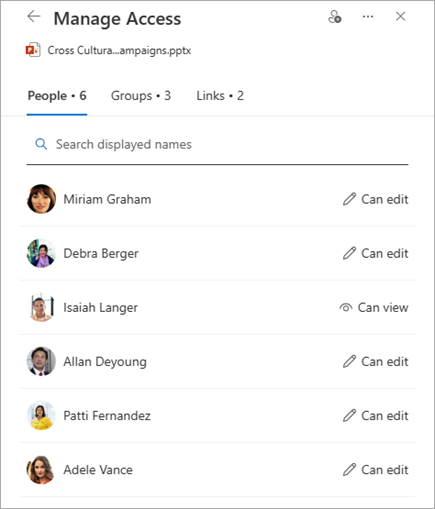
Microsoft’s published Manage Access example separates People, Groups and Links for a sample presentation. Use those routes when reviewing distribution access, alongside the approved audience and asset version. The screenshot does not establish ownership, investor eligibility or legal approval to distribute material.[7] View full-size image
A private equity marketing systems review should prove that communications are classified, claims are supported, accounts are controlled, distribution matches approval, forms minimize data, analytics is safe, CRM statuses are consistent, and controlled materials enter secure diligence only after authorization.
Preserve communication versions, approvals, substantiation, methodology, distribution evidence, account ownership, analytics history, CRM records, and access logs before changing tags, pages, domains, phone numbers, lists, or rooms. Route uncertain marketing-rule and investor-communication decisions to the firm’s compliance and legal reviewers.
ALLMSP's in-house team helps organizations in Lawrenceville, Suwanee, Gwinnett County, Metro Atlanta, and across Georgia audit private equity marketing ownership, data, and handoffs, then validates the result and documents the support path.
Evidence to collect before changing private equity marketing
The review leaves a dated map of communication assets, audiences, owners, claims, approvals, distribution, accounts, response paths, tracking, privacy boundaries, CRM outcomes, secure rooms, and corrective priorities. Every finding names the evidence required to close it.
- Communication inventory with audience, purpose, rule classification, claims, performance, disclosures, reviewers, approvals, distribution, versions, and retention.
- Ownership and access exports for domain, site, CRM, email, events, social, analytics, Tag Manager, Ads, forms, rooms, portals, billing, and recovery.
- Website and search data, campaigns, event and email results, forms, analytics diagnostics, CRM status, meetings, secure handoffs, and outcomes.
- Provider contracts, promoter or endorsement arrangements where used, portfolio permissions, data sources, methodology records, support tickets, and change history.
- Rejected distribution, broken forms and links, privacy findings, duplicate events, former-user access, content due for review, and unexplained reporting gaps.
Review communication scope, claims, ownership, approval, and distribution
Communication inventory and classification
What to check: Sample public, investor, business-owner, intermediary, recruit, and portfolio communications and capture purpose, audience, applicable classification, owner, reviewer, disclosure, access, distribution, approval date, and archived version.
What to do next: Stop or restrict uncertain distribution, assign accountable classification and review, correct access and disclosure, preserve affected versions, and update the inventory and approval workflow.
Claims, performance, and substantiation
What to check: Capture source, calculation, methodology, time period, inclusion and exclusion, gross and net treatment where relevant, fees, assumptions, risks, limitations, permissions, conflicts, disclosures, reviewer, and approval.
What to do next: Correct or remove unsupported or misleading material, obtain required review and permissions, align methodology and context, add approved disclosures, and archive corrected distributions.
Account ownership and publishing authority
What to check: Export owners, administrators, publishers, service identities, recovery methods, payment profiles, last use, history, and provider access. Test backup ownership and export.
What to do next: Add company owners, separate administration and publishing, reduce roles, remove former users and unknown providers, rotate affected credentials, and document recovery, billing, export, and transfer.
The SEC marketing-rule guide applies to advisers registered or required to register with the Commission that disseminate covered advertisements; the responsible reviewer must classify the communication and its audience.[1] Preserve that decision with the applicable SEC FAQ[2] and examination-observation references.[3] Route endorsement or testimonial wording to the responsible reviewer as well.[4] A SharePoint People, Groups and Links review helps identify access routes; it does not determine legal approval to distribute an asset.[7]
Test pages, events, forms, analytics, CRM, and secure handoff
Website usefulness and confidentiality
What to check: Compare each page with its audience, supported claims, portfolio permission, useful answer, confidential boundaries, next step, search intent, response quality, and approved version.
What to do next: Rebuild or consolidate weak pages around a real user task, correct claims and portfolio facts, remove confidential detail, improve mobile and internal links, and route to an approved contact or secure path.
Distribution, list, and access control
What to check: Sample who received what, why they were included, approval scope, disclosure, access expiration, forwarding effect, opt-out or suppression where applicable, secure-room transition, and delivery evidence.
What to do next: Stop inappropriate distribution, correct lists and access, refresh suppression, obtain review, expire rooms, repair links, notify responsible leadership, and preserve the incident and correction record.
Public forms and sensitive-data handling
What to check: Test common audiences and attempts to submit investor documents, target financials, banking details, credentials, deal names, and confidential narratives. Capture every data destination and notification preview.
What to do next: Minimize fields, block or redirect unsafe submissions, remove sensitive values from tracking, secure destinations, restrict access, define retention, and train responders to move follow-up into approved systems.
GA4, Tag Manager, and event integrity
What to check: Test investor, target-company, and portfolio inquiry journeys, then record duplicate, missing, premature, misleading, or sensitive events across each handoff. Reconcile browser tests, debug output, campaign platforms, CRM, and actual approved outcomes.
What to do next: Document the event plan, fire on confirmed success, remove sensitive parameters, deduplicate, correct domains, restrict publishing, test changes, annotate releases, and reconcile on a schedule.
Use synthetic submissions to check the defined Analytics event and its receiving record.[5] Google prohibits sending recognizable personal information to Analytics; review page URLs, titles, form fields and campaign values instead of forwarding inquiry details into measurement parameters.[6]
Reconcile outcomes, records, access, support, and maintenance
CRM response and audience status
What to check: Sample records by source and capture first useful response, owner, status consistency, notes, safe data, audience decision, follow-up, secure material, and final approved outcome.
What to do next: Define statuses and ownership, correct failed notifications, remove unnecessary sensitive data, establish response and escalation, train users, and require authorization before controlled access.
Source-to-outcome reconciliation
What to check: Match non-sensitive records from source through outcome and quantify unknown source, duplicate event, unsupported audience, missing status, failed handoff, and platform totals that cannot be explained.
What to do next: Standardize approved identifiers and statuses, repair event and routing gaps, reconcile on a schedule, and report approved relationships and response quality alongside visibility.
Content, access, and approval maintenance
What to check: Identify stale facts, portfolio changes, outdated performance, orphaned pages, missing approvals, former-user access, broken paths, recurring failures, and assets without a current purpose or owner.
What to do next: Assign owners and review frequency, update or restrict material, repair links, archive versions, remove stale access, correct workflows, and verify user, search, compliance, and reporting effects.
Prioritize misleading, confidential, ownership, and data-integrity risk
Report findings by communication, audience, claim, entity, confidential information, account ownership, response path, data reliability, evidence, immediate correction, long-term owner, due date, and retest. Separate a visibility problem from a review, distribution, form, CRM, or reporting problem.
Priority 1: Misleading, confidential, or ownership failure
Act immediately on unsupported material claims, incorrect performance presentation, exposed deal or investor information, uncontrolled distribution, lost company ownership, compromised forms or tags, and unauthorized publishing or room access.
Priority 2: Broken approval or response path
Urgently repair missing review evidence, failed forms, unsafe follow-up, broken room handoff, inconsistent CRM status, duplicate analytics, missed inquiries, and controlled materials sent outside approved scope.
Priority 3: Usability and visibility weakness
Improve unclear public pages, stale portfolio facts, weak mobile experience, poor internal links, low-quality discovery, inconsistent accounts, and incomplete reporting after trust and data integrity are controlled.
Priority 4: Growth experiment
Test new channels, audiences, events, content, automation, and paid distribution only with documented scope, approval, capacity, privacy, measurable outcome, and stop rules.
Illustrative release gate: a deck, a room invitation and an inquiry event
These hypothetical records demonstrate decisions and missing proof. They are not measured investor outcomes or a legal-compliance certification.
| Sample | Observed condition | Release decision and next proof |
|---|---|---|
| Approved deck version A | The audience decision names one segment, but a forwarded room invitation reaches another | Pause that distribution; have the responsible reviewer resolve the audience and preserve the earlier distribution record |
| A material numerical claim | The slide has approval initials but no underlying period or calculation | Hold the claim for review; attach substantiation, limitations and the approved version before release |
| Synthetic web inquiry | One CRM record arrives, but an email address appears in the Analytics page URL | Treat the measurement path as failed; stop the PII transmission and retest with synthetic values |
| An agency transition | Website access transfers but domain recovery remains tied to the agency mailbox | Keep ownership unresolved; prove company-authorized recovery and separately review integrations |
Use Find Access and Recovery Risks Across Portfolio Companies for the separate entity, recovery and incident-control review. Use Google Marketing Access Review: Who Should Control Each Account? to assign company administration, publishing and recovery responsibilities across Google marketing accounts.
Official guidance and ALLMSP resources
Frequently Asked Questions
How can a private equity firm audit its communication inventory?
Inventory the versions people actually receive, including decks, emails, event material and room invitations, rather than just the public website. For a small sample, connect the exact version to its intended audience, owner, reviewer, approval and distribution record. Ask the firm’s compliance lead to classify communications where applicable. A link to today’s edited page does not preserve what an earlier recipient saw.
What evidence should a private equity firm retain for marketing claims?
Keep the source evidence and approved presentation together: the exact claim, underlying data, calculation or methodology, relevant period, limitations, reviewer and distributed version. An unsupported number should be held for review instead of made safer with a vague disclaimer. SEC adviser-marketing requirements have a defined scope; the firm’s responsible reviewer should determine applicability and approve any performance, testimonial or endorsement treatment. This systems check does not determine legal compliance.
How should private equity firms review ownership of marketing and investor platforms?
Confirm that company-authorized people control administration, recovery and billing independently of a departing employee or agency. Test a second permitted administrator before removing the old one, and inspect connected managers, integrations and publishing access separately. Possession of a website password or an advertising login does not prove control of the domain, payment profile or investor portal. Record the transfer and the access that remains intentionally delegated.
How can a private equity firm review whether its website is useful and safe?
Choose a real visitor task and follow it from the landing page to the approved next step on a phone and desktop. The page should explain the audience, purpose and relevant next action without exposing confidential material or relying on unsupported claims. Compare actual inquiry quality with the page’s intended audience. Consolidate overlapping pages when they serve the same task, and preserve the useful URL or provide a relevant redirect when consolidation is approved.
How should private equity firms audit distribution of controlled materials?
Match each sampled recipient or audience segment to the specific approved version and distribution purpose. Check expired room access, forwarding and suppression where applicable; an approved document is not automatically approved for every audience. Preserve the distribution record before correcting an error. If the scope is uncertain, stop that distribution and obtain the responsible review rather than treating a CRM status as authorization to receive controlled material.
How can private equity firms keep website and event forms from collecting sensitive data?
Use a short initial inquiry form and move sensitive documents or deal details to an approved secure follow-up process. Test with synthetic data and trace every destination, including notification previews, CRM fields, URLs and analytics events. Removing a visible field does not remove a value already sent to another service. Correct the collection and sharing path, review existing records with their owner and define who may access them.
What should private equity firms verify in GA4 and Tag Manager?
A conversion should represent the intended confirmed action once, without sending personal or confidential form values to Analytics. Test successful submission, validation failure, repeated clicks and the CRM handoff with synthetic data. Compare the browser event with the receiving record; a tag firing does not prove a qualified inquiry or an approved investor relationship. Restrict publishing and keep a release record so a later discrepancy can be traced.
How should private equity firms review CRM audience and response statuses?
Separate the stage of the relationship from permission to receive material. For example, received, assigned and meeting held describe progress; audience eligibility or controlled-room approval requires its own responsible decision. Give each live inquiry one owner, a next action and an escalation path when that owner is unavailable. Use a sample of actual records to find ambiguous statuses or failed notifications instead of adding more labels without a working process.
How can a private equity firm verify marketing source-to-outcome reporting?
Reconcile a sample through a non-sensitive internal identifier from the original inquiry to its approved outcome. Report unmatched records, duplicates and unknown sources alongside the matched results. Different platform counts may describe different events, time windows or attribution models; do not force them to agree by relabeling every event a relationship. Keep the identifiers inside approved systems and do not put confidential deal names or personal details into tracking parameters.
How often should private equity firms review marketing systems and approved content?
Set an owner and review trigger for each asset. Review immediately after a material portfolio, team, claim, access or provider change, and use a documented recurring check for stable material. The interval should reflect the risk and rate of change rather than a universal monthly or annual rule. Preserve prior approved versions and record what changed so reviewers can distinguish a routine content update from a changed audience or distribution decision.
Sources
- SEC investment adviser marketing rule compliance guide ↩
- SEC marketing compliance frequently asked questions ↩
- SEC observations on adviser marketing rule compliance ↩
- FTC endorsement and testimonial guidance ↩
- Google Analytics event documentation ↩
- Google Analytics: Avoid sending personally identifiable information ↩
- Microsoft: See who a file is shared with in OneDrive or SharePoint ↩