




























































































































































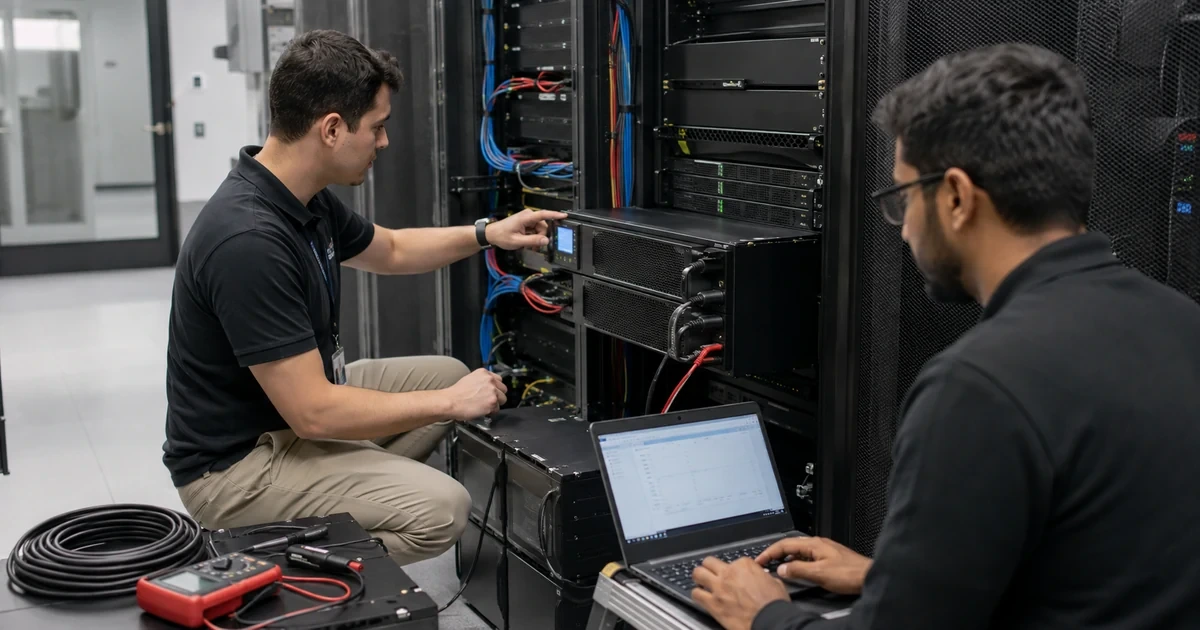
An APC Smart-UPS can report online while still being unfit for the business service attached to it. A recently added server may push the protected load beyond the planned margin, a printer may occupy a battery-backed outlet, a replacement battery may be the wrong cartridge, or a graceful shutdown may require more time than the displayed estimate. Commissioning therefore has to prove the whole path from utility circuit through UPS, batteries, outlet groups, equipment power supplies, management interface, and application shutdown sequence.
APC’s current Smart-UPS operation manual spans different tower and rack models and calls out model-specific installation, electrical and battery safety, outlet groups, display settings, SmartConnect, emergency power off, replacement procedures, and service. APC’s battery guidance adds that elevated temperature, poor input power, repeated discharge, storage, and high load reduce life and recommends avoiding sustained operation above eighty percent of rated capacity. Those facts support a controlled engineering margin, they do not create a universal runtime promise for every UPS family.
This runbook is for qualified IT, facilities, and electrical teams. It does not authorize untrained staff to open energized equipment, alter building wiring, service internal power electronics, lift heavy battery modules alone, or bypass local code. Exact product manuals, electrical requirements, site safety procedures, and Schneider Electric support instructions govern the physical work. The operational objective is simple: every protected service should have an evidence-backed load, runtime, shutdown result, battery state, owner, and next review date.
Companies across Lawrenceville, Suwanee, Gwinnett County, Metro Atlanta, and Georgia can bring ALLMSP in to commission APC Smart-UPS systems for load, runtime, and safe failover. We coordinate the affected technology and business workflow through our own team.
Key decisions at a glance
- Inventory the exact APC Smart-UPS SKU, UPS ID, firmware, input and output voltage, rated watts and VA, plug, branch circuit, battery cartridge, external battery packs, outlet groups, protected equipment, and support state.
- Size from measured sustained and startup load, power factor, required shutdown time, battery aging, growth, environmental conditions, and the model’s official runtime data rather than summing nameplate watts alone.
- Commission direct utility input, rack support, ventilation, battery connections, grounding, outlet-group dependencies, alerting, self-test, and controlled failover before the UPS protects production equipment.
- Treat a self-test, a runtime estimate, and a runtime calibration as different controls, APC documents prerequisites for calibration and warns that frequent deep discharge reduces battery life.
- Reconcile alarms, battery age, ambient temperature, firmware, replacement battery cartridges, recycling evidence, service cases, capacity changes, and retirement so a silent UPS does not become assumed protection.
Map the Exact APC UPS, Circuit, Battery, and Protected Load

Start with a restricted asset record for each APC system. Capture product family, complete SKU, serial, manufacture or purchase date, UPS ID, chassis firmware, Network Management Card model and firmware if present, nominal input and output voltage, rated apparent power in VA, rated real power in watts, plug and receptacle types, branch circuit, breaker, rack position, rail kit, weight, grounding path, emergency power-off design, internal battery cartridge, external battery-pack quantity, outlet groups, warranty, service plan, and physical location. Photograph labels for the protected record but keep serials, IP addresses, rack names, floor plans, and customer identifiers out of public tickets and articles. Build a connected-load register at device and power-supply level. For each server, switch, storage array, firewall, modem, console, environmental monitor, and other dependency, record normal watts, measured peak, startup or inrush behavior, redundant power supplies, A/B source, shutdown priority, minimum hold-up time, and restart order. Do not count dual power supplies as redundancy if both cords land on the same UPS, PDU, branch, or outlet group. Exclude laser printers, space heaters, motors, vacuum cleaners, and other high-inrush or non-IT loads unless the exact APC model documentation and engineering design explicitly support them. Size the UPS from measured demand and the required business outcome. Add realistic growth, conversion loss, battery aging, ambient temperature, and time for detection, decision, workload drain, application stop, operating-system shutdown, and uncertainty. Compare both watts and VA because a unit must stay within each rating. Use the official runtime chart or selector for the exact SKU and battery-pack configuration, then validate the installed result. APC’s general battery guidance recommends keeping load below eighty percent of rated capacity, many services require a larger reserve because redundancy, future expansion, or shutdown duration drives the design. Record the chosen ceiling and why it is adequate rather than repeating a single percentage as policy. A useful one-line acceptance statement names the actual load, planned maximum, required runtime, tested runtime, battery age, outlet-group design, and shutdown owner.
- Record exact APC SKU, serial, UPS ID, firmware, NMC, voltage, watts, VA, plug, receptacles, circuit, breaker, rack, batteries, external packs, outlet groups, warranty, and support.
- Map every connected power supply to normal and peak demand, A/B source, criticality, shutdown duration, restart dependency, and owner.
- Keep redundant power paths on genuinely independent UPS, PDU, branch, and outlet infrastructure where the design requires it.
- Exclude unsupported high-inrush and non-IT equipment and leave margin for growth, heat, battery aging, conversion loss, and shutdown uncertainty.
- Base runtime on the exact model and battery configuration, then prove it against the installed load.
Install, Configure, and Accept the APC Smart-UPS Safely

Schedule physical installation with the personnel and lifting method required by the product and site. Verify receiving condition, exact model, rail and rack compatibility, airflow, clearances, ambient temperature, humidity, dust exposure, water risk, cable reach, branch rating, plug, ground, and service access before mounting. Heavy battery modules belong low in the rack according to the applicable guide, upstream and downstream work must follow electrical code and the organization’s lockout or de-energization procedures. APC manuals commonly direct applicable cord-connected UPS units to a wall outlet rather than a surge strip or extension cord. Treat that as an installation control and escalate any site whose receptacle or circuit cannot support the selected unit. Connect internal batteries and approved external packs exactly as documented, then allow the required initial charge. Confirm that the UPS recognizes each pack and that no battery-disconnected, wiring, bypass, overload, temperature, or internal fault remains. Configure nominal output, sensitivity or power-quality behavior, low-battery duration, audible alarms, automatic self-test cadence, outlet-group names, power-on and power-off delays, load-shedding order, restart behavior, and management integration for the exact service. Group dependencies deliberately: network and storage may need to remain energized while application hosts shut down, while noncritical lab or edge loads may shed earlier. Do not use switched groups as an informal remote-control shortcut without a documented dependency map. Establish monitoring before production cutover. Alert on on-battery, low runtime, battery replacement, overload, high temperature, lost communication, bypass, failed self-test, disconnected pack, output off, and internal fault through at least one path that does not depend solely on the protected rack. Set time, identity, contacts, and notification destinations without placing credentials or sensitive location data in names. Run the built-in self-test and inspect display, LEDs, event log, battery charge, estimated runtime, load percentage, input and output values, outlet states, and external pack count. Resolve every unexplained alarm rather than clearing it for a green dashboard. Acceptance concludes with a signed wiring and outlet map, safe photos with labels protected, configuration export where supported, alert proof, baseline measurements, and a rollback plan.
- Verify exact equipment, rack support, lift plan, airflow, temperature, moisture risk, branch circuit, grounding, plug, clearance, and service access before energizing.
- Follow the model guide for battery connections, initial charge, external packs, direct utility input, EPO, and qualified electrical work.
- Configure power quality, alarms, self-test, low-battery timing, outlet delays, load shedding, restart behavior, monitoring, and time synchronization for the actual service.
- Prove notifications through an independent path and investigate every wiring, battery, overload, bypass, temperature, communication, or internal fault.
- Preserve a protected acceptance package containing topology, outlet map, measurements, configuration, images, alert evidence, owners, and rollback.
Prove Runtime, Outlet Sequencing, and Graceful Failover

Separate three often-confused tests. A self-test is a short internal battery health check. The displayed runtime is an estimate derived from load and battery information. A runtime calibration is a controlled discharge intended to improve that estimate and is not a casual health test. APC’s SMX, SMT, SRT, and SRTL calibration guidance requires full battery charge, no battery fault or overload, no pending switched-outlet change, and a minimum load that rises with external battery-pack count. APC also recommends no more than one or two calibrations per year because repeated deep discharge shortens battery life, certain lithium-ion Smart-UPS models do not support calibration at all. Use the exact product and firmware guidance before initiating one. The business test should instead prove the outage timeline at a safe, planned window. Freeze load changes, confirm backups and recovery, assign a test leader, application owners, facilities contact, observer, stop authority, and rollback. Capture initial charge, load watts and VA, estimate, battery age, temperature, outlet states, event-log time, and service health. Simulate the approved loss-of-utility condition using the site procedure without unsafe plug pulling or work inside energized panels. Verify that the UPS goes on battery, alerts arrive, noncritical outlet groups shed in the intended order, network and storage remain available long enough, shutdown software or operating procedures begin at the chosen threshold, applications stop cleanly, hosts power down, and the UPS retains reserve rather than reaching uncontrolled exhaustion. Stop for abnormal smell, smoke, heat, sound, swelling, unstable output, unexpected load loss, battery fault, severe voltage issue, or any condition named by safety leadership. Restore utility and confirm stable online operation, charger state, outlet restart sequence, application recovery, event chronology, alert clearance, battery recharge, and incident-free service. Compare measured milestones with the design: detection time, decision delay, load-shed time, application stop, host shutdown, remaining runtime, and restart. A passing result proves required service behavior with a documented reserve. It does not justify draining the battery to zero or repeating a deep test after every change. For later hardware additions, rerun capacity analysis and a proportionate functional test before connecting production load.
- Distinguish short self-test, runtime estimate, runtime calibration, and full business failover, each answers a different question.
- Check model-specific calibration support and prerequisites, and avoid unnecessary deep discharges that accelerate battery wear.
- Rehearse with named owners, frozen load, stop conditions, backups, safety approval, telemetry, and a recovery plan.
- Verify alerts, load shedding, dependency order, application stop, host shutdown, reserve, utility return, outlet restart, recharge, and event chronology.
- Recalculate and retest proportionately whenever protected load, battery packs, outlet groups, shutdown timing, firmware, or applications change.
Maintain Batteries, Firmware, Alarms, Recycling, and Retirement
Operate a monthly exception review and a quarterly engineering review. Trend load, peak demand, on-battery events, transfer frequency, input voltage, temperature, self-test outcomes, replace-battery alarms, runtime estimate, battery age, communication loss, bypass, overload, outlet actions, and unresolved cases by exact APC model and site. Repeated transfers may point to poor utility quality or sensitivity settings, but changes require product guidance and an electrical assessment, do not merely widen thresholds until alarms stop. APC says many VRLA UPS batteries last roughly three to five years, with heat, poor mains power, frequent discharge, storage, and load affecting life. Treat age as a planning input, not proof that a particular cartridge is healthy. Inspect accessible external condition without opening sealed assemblies, and act immediately on swelling, leakage, odor, abnormal heat, corrosion, damage, or a replace-battery indication. Use the exact APC Replacement Battery Cartridge specified for the UPS and replace coordinated module sets where the guide requires it, mixing unmatched ages or unsupported third-party assemblies can leave runtime estimates and safety assumptions invalid. Battery replacement is not complete until the UPS recognizes the cartridge, charge stabilizes, self-test passes, runtime and alarm baselines are updated, and the removed battery has controlled custody. APC’s U.S. recycling guidance says eligible official RBC packages include a return route and directs other products to approved recycling options. Follow the current regional instruction, transportation rules, facility requirements, and safety plan rather than putting sealed lead-acid batteries in ordinary waste. Manage UPS and NMC firmware separately by exact model, UPS ID, application, current release, compatible file, prerequisite, outage impact, configuration backup, pilot, monitoring, and rollback. Schneider Electric’s firmware reference emphasizes matching the file to the exact series and UPS ID. Never assume a familiar filename applies to a near-match chassis. Finally, compare battery replacement with whole-unit renewal. APC notes that aging UPS electronics, fans, capacitors, support status, load growth, and warranty can make chassis replacement more sensible than another cartridge. Retire only after protected load has migrated, monitoring and shutdown registrations are removed, batteries and electronics enter qualified disposition, configuration and credentials are cleared where supported, asset and financial records reconcile, and the production owner signs off.
- Review load, transfers, temperature, self-tests, battery age, runtime, alarms, bypass, overload, outlet actions, communications, and incidents by exact model and site.
- Replace only with the correct APC RBC or approved service plan and verify recognition, recharge, self-test, runtime baseline, alarm clearance, custody, and recycling.
- Match UPS and management firmware to exact hardware, application, UPS ID, prerequisites, current state, pilot, outage window, and rollback.
- Investigate input-quality and sensitivity patterns with qualified personnel rather than silencing symptoms.
- Compare battery-only repair with chassis renewal and close migration, credentials, monitoring, assets, finance, support, and qualified disposition together.
Official product documentation and ALLMSP resources
- Schneider Electric: Smart-UPS operation manual
- APC: Expected life of a UPS VRLA battery
- Schneider Electric: Smart-UPS X operation manual
- Schneider Electric: APC recycling options
- Schneider Electric: Smart-UPS firmware versions and release notes
- ALLMSP APC Hardware Support
- ALLMSP Hardware Support
- ALLMSP IT Consulting
- ALLMSP Managed IT Services
- ALLMSP Cybersecurity Services
- Contact ALLMSP
Frequently Asked Questions
Should APC Smart-UPS sizing use watts or VA?
Use both. The installed load must remain within the model’s real-power watt rating and apparent-power VA rating, with margin for startup behavior, growth, battery aging, heat, conversion loss, and shutdown uncertainty.
Is eighty percent load an acceptable target for every APC UPS?
APC’s general battery guidance advises avoiding loads above eighty percent of rated capacity, but the correct design margin also depends on runtime, redundancy, growth, environment, and service criticality. Record a justified ceiling for each system.
What is the difference between an APC self-test and runtime calibration?
A self-test is a short battery health check. Calibration deliberately discharges the battery to improve runtime estimation and has strict prerequisites. It should not be run frequently, and some lithium-ion Smart-UPS models do not support it.
Can a technician test failover by unplugging a production UPS?
Only if the exact product, electrical design, site procedure, safety approval, and test plan authorize that method. Use a controlled window with stop authority, monitoring, recovery, and qualified facilities or electrical staff.
Why can displayed APC runtime differ from actual outage time?
Load changes, battery age, temperature, external battery configuration, recent discharges, estimate calibration, and shutdown activity all affect the result. Prove the required business timeline with safe staged testing and reserve.
Should dual server power supplies connect to the same APC UPS?
Not when the design requires redundant power. Confirm that each path is independent through UPS, rack PDU, branch circuit, and upstream infrastructure, two cords on one failure domain are not true A/B power.
How often should APC UPS batteries be replaced?
Many APC VRLA batteries are expected to last about three to five years, but temperature, input power, discharge history, load, storage, alarms, and inspection determine the actual plan. Replace immediately when the exact guide or safety condition requires it.
Can any APC Replacement Battery Cartridge fit a similar UPS?
No. Match the precise UPS model and approved RBC, and follow the documented module-set and service procedure. Similar enclosure size does not prove electrical, mechanical, firmware, or warranty compatibility.
Does updating an APC Network Management Card update UPS firmware?
No. Management-card and UPS firmware are separate baselines. Match each update to exact hardware, application, UPS ID, compatible release, prerequisites, pilot result, outage impact, and rollback.
How can ALLMSP support APC Smart-UPS fleets?
ALLMSP can inventory exact systems, model load and runtime, document circuits and outlet groups, commission monitoring, stage failover, govern batteries and firmware, reconcile incidents, and plan safe replacement or retirement.