






















































































































































A monitoring deployment fails when the tool is installed before the environment is understood. Discovery may find devices, but it does not know which circuit feeds a site, which switch carries phones, which certificate expires before a sales event, or who can approve a firewall change after hours. Implementation needs technical coverage, secure access, service context, reliable alert delivery, and tested response.
Treat launch as an infrastructure project. Define goals, sites, cloud environments, supported products, collectors, network paths, credentials, protocols, data retention, dependencies, severity, maintenance rules, notifications, dashboards, documentation, and acceptance tests. Build the first checks around the services that would create the greatest customer or operational effect if they failed.
ALLMSP deploys network monitoring for Lawrenceville, Suwanee, Gwinnett County, Metro Atlanta, and organizations elsewhere in Georgia. We perform discovery, install and secure collectors, configure vendor-supported telemetry, map services, establish baselines, build alert routes, test failure scenarios, train customer contacts, and manage the platform after launch.
Launch monitoring as a tested operational service
- Set objectives: Define priority services, locations, response hours, security needs, compliance duties, and measurable launch outcomes.
- Discover assets: Reconcile network scans, configurations, controllers, cloud resources, circuits, inventories, and physical inspection.
- Secure collection: Use protected collectors, encrypted protocols, least-privileged credentials, restricted paths, logging, and backups.
- Build context: Name assets, map dependencies, record owners, attach runbooks, and connect alarms to business services.
- Pilot signals: Establish normal behavior, test representative failures, verify routing, and tune severity before broad activation.
- Accept operation: Confirm coverage, data freshness, dashboards, after-hours delivery, escalation, recovery, documentation, and support.
Define monitoring goals and discover the full environment
Interview business and technical owners before configuring checks. Identify operating hours, critical sites, customer-facing systems, remote workforce, transaction periods, production deadlines, life-safety boundaries, regulatory logging, acceptable downtime, notification preferences, and who can authorize action. Agree on what is monitored continuously, what receives business-hours attention, which events need immediate phone escalation, and which systems require local or manufacturer involvement.
Discover from multiple sources. Review diagrams, firewall and switch configurations, wireless controllers, DHCP, DNS, cloud consoles, virtualization, endpoint tools, circuit bills, public addresses, certificates, VPNs, voice systems, power protection, warranties, support contracts, and physical racks. Verify identity and purpose rather than importing every responding address as a useful asset. Flag unknown equipment, duplicate names, unmanaged devices, unsupported software, undocumented uplinks, weak credentials, and single points of failure for correction.
- Business requirement: Record priority services, operating windows, outage tolerance, contacts, customer effect, and decision authority.
- Technical discovery: Combine active scans, device configurations, controller data, cloud inventory, circuit records, and site inspection.
- Identity standard: Assign clear names, device type, model, version, site, role, owner, support, and lifecycle state.
- Dependency record: Map uplinks, power, circuits, tunnels, authentication, DNS, servers, applications, and cloud connections.
- Launch risk: Track unknown devices, unsupported products, missing access, weak protocols, hidden links, and absent recovery data.
Implementation begins on solid ground when the monitored population and its business purpose are both understood.
Install secure collection and build meaningful telemetry
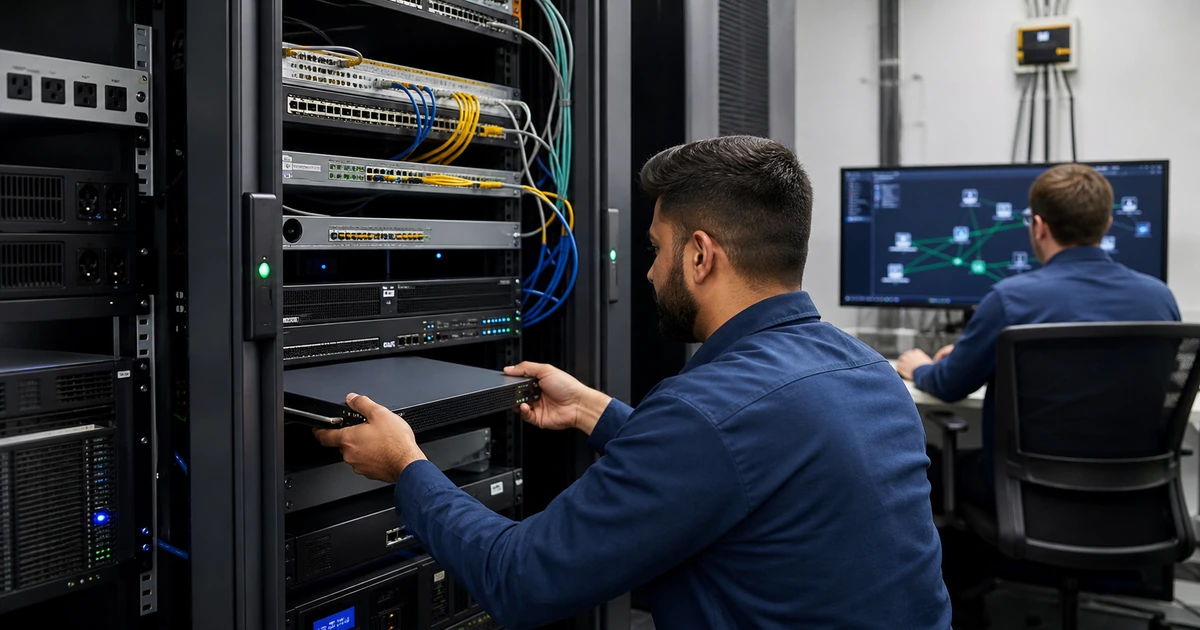
Place collectors where they can observe required systems without creating broad trust. Document hosting, operating system, capacity, network access, DNS, time synchronization, backup, recovery, update method, and ownership. Use encrypted and authenticated protocols where products support them. Prefer least-privileged read access for routine collection, separate credentials for approved actions, and named administrative accounts with multifactor authentication. Restrict source addresses and management interfaces, rotate secrets, log access, and verify what sensitive information the platform stores.
Configure telemetry by device and service class. Collect reachability, interface state, errors, throughput, latency, loss, jitter, route and tunnel health, CPU, memory, storage, temperature, fans, power supplies, wireless clients, certificate dates, service processes, hardware alarms, configuration changes, and logs that support diagnosis or security. Set poll intervals and retention according to how quickly a condition matters and how much history is needed. Add a check for the collector and data pipeline so missing telemetry cannot masquerade as a healthy environment.
- Collector design: Plan location, resilience, capacity, network path, time, name resolution, updates, backup, and recovery.
- Credential model: Separate read collection from administrative action and apply least privilege, logging, rotation, and multifactor protection.
- Protocol review: Use supported encrypted management methods and restrict legacy protocols to tightly controlled conditions.
- Signal profile: Choose availability, performance, error, capacity, hardware, service, security, configuration, and log data by role.
- Pipeline health: Alert when collectors, integrations, notification channels, storage, licensing, or telemetry freshness fail.
Secure collection provides enough evidence to diagnose a problem without turning the monitoring platform into unnecessary administrative risk.
Pilot alerts, test response, and complete launch acceptance
Observe normal daily and weekly behavior before setting tight thresholds. Account for backups, cloud synchronization, batch processing, opening and closing hours, shift changes, guest use, software releases, and known bandwidth peaks. Create alerts with persistence, severity, dependencies, ownership, and maintenance behavior. Test controlled conditions such as disconnecting a pilot interface, stopping a noncritical service, changing a test configuration, failing a notification route, and marking scheduled maintenance. Confirm that the correct person receives enough context through the expected channel.
Run tabletop and practical response checks. Have responders acknowledge, navigate the service map, use the runbook, review evidence, communicate with a business contact, escalate a simulated carrier or product case, and validate restoration. Complete acceptance with reconciled coverage, documented exclusions, current credentials, tested notifications, working dashboards, verified retention, configuration backup, support procedures, user contacts, and an improvement backlog. Schedule a tuning review after real operations produce enough alert history.
- Baseline window: Capture normal business cycles, backup periods, peaks, quiet hours, planned changes, and seasonal activity.
- Controlled test: Exercise reachability, interface, service, threshold, configuration, collector, notification, and maintenance scenarios.
- Routing proof: Verify email, text, phone, ticket, acknowledgment, after-hours escalation, and failed-delivery handling.
- Response rehearsal: Test evidence review, runbook use, business communication, carrier escalation, restoration, and closure.
- Acceptance record: Document coverage, exclusions, credentials, data, dashboards, contacts, recovery, risks, and follow-up owners.
The launch is complete when monitoring and response work together under realistic conditions, not when device discovery reaches a target count.
Network monitoring implementation from ALLMSP
ALLMSP can define requirements, reconcile network and cloud assets, install monitoring collectors, secure credentials and protocols, create service maps, and configure the signals appropriate to each system. We also document circuits, dependencies, contacts, and response procedures.
Our in-house team pilots alerting, tests notifications and failure cases, trains stakeholders, corrects launch gaps, and operates the resulting platform. This keeps the implementation tied to response quality and business availability from the first day.
- Discover: Verify assets, sites, circuits, dependencies, owners, support, risk, and business requirements.
- Configure: Deploy secure collection, relevant telemetry, naming, maps, thresholds, routing, and maintenance controls.
- Validate: Test failures, notifications, escalation, runbooks, recovery, dashboards, and launch acceptance.
Official references for monitoring implementation
A monitoring platform should support a defined strategy, collect reliable evidence, protect its own access, and enable timely response to observed risk.
- NIST continuous monitoring strategy. Describes continuous visibility into assets, threats, vulnerabilities, and the effectiveness of security controls.
- NIST computer security log management. Provides enterprise guidance for log infrastructure, generation, transmission, storage, access, analysis, and disposal.
- CISA monitoring and hardening advisory. Uses red-team findings to illustrate the need for host and network visibility, baselines, and tuned detection.
- ALLMSP network and cabling services. Supports cabling, connectivity, equipment installation, testing, labeling, and physical network improvements.
Network monitoring deployment FAQs
What information is needed before monitoring is installed?
Gather sites, devices, circuits, cloud resources, configurations, support records, business priorities, contacts, operating hours, access, and recovery requirements.
Can network discovery find every important dependency?
No. Discovery helps identify technology, but interviews, configurations, circuit records, cloud consoles, application knowledge, and physical inspection add essential context.
Where should a monitoring collector be installed?
Place it where required systems are reachable and the collector can be secured, maintained, backed up, monitored, and recovered without excessive trust.
Should monitoring use administrator credentials?
Routine collection should use the least privilege available. Separate protected identities should be used for any authorized administrative action.
Which telemetry should a firewall provide?
Useful signals can include reachability, interfaces, throughput, errors, tunnels, resources, hardware health, configuration changes, authentication, security events, and logs.
How long does it take to establish a baseline?
Capture enough normal business cycles to include peaks, quiet periods, backups, opening and closing, remote work, and planned maintenance.
How are alert routes tested?
Generate controlled events and confirm delivery, ticket creation, acknowledgment, phone escalation, failed-channel handling, and business communication.
What should a launch acceptance report contain?
Include coverage, exclusions, data freshness, access, notifications, dashboards, runbooks, contacts, recovery, unresolved risk, and follow-up dates.
Can ALLMSP implement and operate the monitoring platform?
Yes. ALLMSP handles discovery, installation, configuration, security, testing, response, documentation, tuning, and support in house.
Which local areas can receive network monitoring setup?
ALLMSP deploys network monitoring for Lawrenceville and Suwanee organizations, including distributed sites across Gwinnett County, Metro Atlanta, and Georgia.