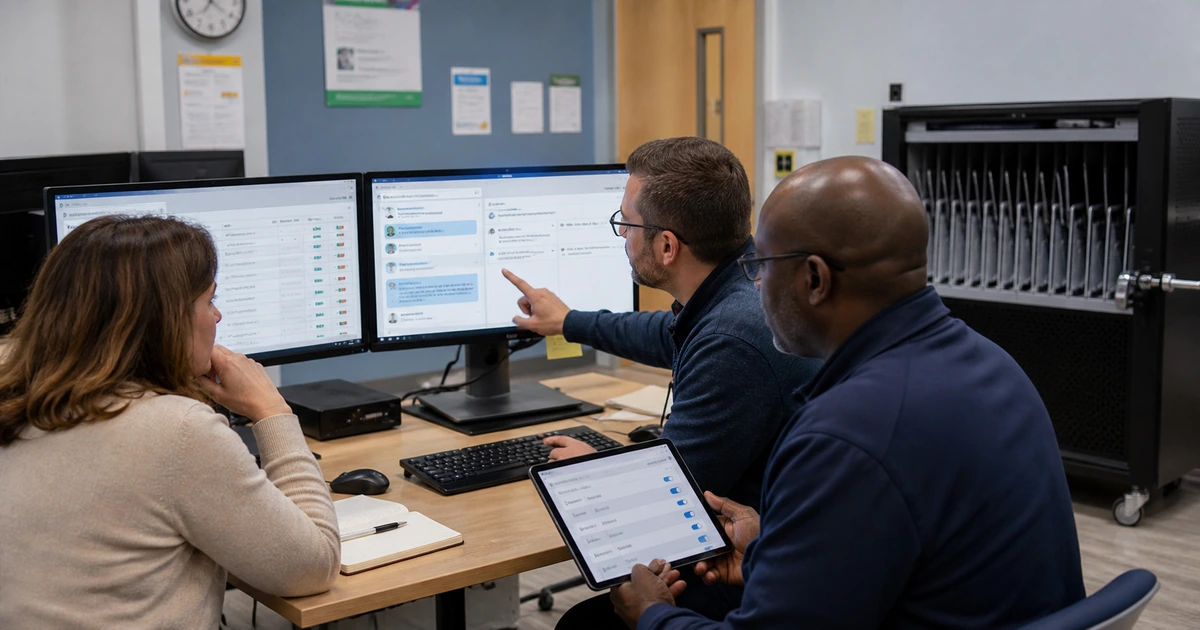









































































































































An AI training audit asks whether employees can perform approved work safely without the instructor beside them. Attendance records and course completion show exposure to material, not proficiency. The audit should sample what people were taught, observe what they actually do, test difficult cases, compare behavior with policy and platform controls, and identify whether a problem belongs to training, process design, data, access, or the technology itself.
Audit by role and consequence. A marketing employee drafting an internal outline needs different evidence from a finance user analyzing records, a customer-service agent preparing a response, or an administrator publishing an AI agent. The review should verify tool selection, information handling, instruction quality, source use, factual and numerical checks, human approval, incident reporting, and the ability to recognize a task that should not use AI.
ALLMSP audits and improves AI training for Lawrenceville, Suwanee, Gwinnett County, Metro Atlanta, and organizations across Georgia. Our internal team can inspect technical readiness, curriculum, exercises, proficiency, usage, support trends, and business outcomes, then implement the needed corrections.
Collect evidence from curriculum, behavior, systems, and outcomes
- Review the program: Inspect audience definitions, learning outcomes, materials, exercises, instructors, attendance, assessments, and updates.
- Test role proficiency: Observe representative tasks, difficult cases, information decisions, verification, correction, and escalation.
- Inspect prompt practice: Check task clarity, context, source boundary, output format, constraints, iteration, and uncertainty handling.
- Inspect data handling: Check managed accounts, classification, minimization, masking, source permissions, sharing, and retention.
- Compare system evidence: Review licenses, active use, agents, connectors, access, support, incidents, errors, and costs.
- Assign improvements: Separate training gaps from configuration, process, data, access, management, and tool limitations.
Audit curriculum coverage and the evidence of learning
Compare the intended audience with actual attendees and access. Confirm that the program distinguishes employees, managers, reviewers, builders, and administrators. Review whether learning outcomes describe observable behavior, and whether exercises cover the approved tools and current interfaces. Check that materials explain limitations, information boundaries, verification, human decision points, prohibited uses, incident reporting, and support. Find stale product screenshots or instructions that no longer match configuration.
Examine assessment quality. A multiple-choice quiz can confirm awareness, but it rarely proves that an employee will protect data or catch a plausible error. Look for hands-on exercises, expected results, scoring rubrics, retry opportunities, instructor notes, and records of remediation. Check whether employees completed training before receiving access to higher-consequence features. Verify that temporary users, transfers, new hires, contractors, and remote staff are included in the assigned learning path.
- Audience coverage: Compare roles, locations, employment status, access, use cases, training assignment, and completion.
- Current material: Verify product behavior, account type, policy, data rules, screenshots, examples, and support contacts.
- Role relevance: Match exercises with actual tasks, sources, decisions, exceptions, and consequences.
- Assessment quality: Require demonstration, verification, correction, judgment, explanation, and exception handling.
- Remediation evidence: Record failed skill, feedback, additional practice, reassessment, result, and access decision.
The program should prove that each audience can perform required behavior, not merely that a course link was opened and marked complete.
Observe prompt practice, data handling, and output verification
Give sampled employees a safe task that resembles normal work and ask them to think aloud. Observe whether they choose the managed account, understand the requested outcome, provide appropriate context, identify authoritative sources, and define a useful output. Introduce missing information or a conflicting source. Check whether the employee asks for clarification, limits the answer, or confidently proceeds. Ask them to show how they would preserve or remove earlier conversation context.
Include a plausible but wrong result. Ask the employee to verify facts, dates, names, calculations, citations, policy, tone, and customer commitments. Test a sensitive-data scenario and watch whether they minimize, mask, avoid, or escalate the input. For builders, inspect instructions, retrieval boundaries, permissions, test sets, human approval, logs, release control, and rollback. Record behavior without collecting unnecessary personal or confidential information in the audit evidence.
- Tool choice: Use the approved product, tenant, account, application, feature, and source connection.
- Instruction quality: State role, task, context, sources, audience, format, constraints, and uncertainty treatment.
- Information handling: Apply classification, minimization, masking, permission, sharing, retention, and prohibited-use rules.
- Verification: Check facts, calculations, source context, omissions, suitability, bias, policy, and required approval.
- Exception judgment: Recognize when to correct, reject, use a manual process, report a concern, or obtain qualified help.
Observed work reveals whether an employee can apply the rules when the output looks convincing and the correct answer is not obvious.
Connect training findings with adoption, support, and business results
Compare proficiency with system and support evidence. Review enabled and active users, feature patterns, repeated use, unused licenses, agent inventory, connectors, access, data-control alerts, support questions, and incidents. High activity with weak verification may increase risk. Low activity may reflect missing skill, but it can also reveal unsuitable use cases, poor data, unclear manager expectations, technical barriers, or a tool that does not fit the work.
Write each finding with the affected role, evidence, consequence, root-cause hypothesis, correction, owner, due date, and retest. Choose the right remedy. Update a lesson when employees misunderstand a concept. Change configuration when the approved path is hard to reach. Improve the process when inputs are inconsistent. Correct permissions when source access is excessive. Adjust management expectations when employees are rewarded for volume instead of verified quality. Retire a use case when evidence does not support it.
- Adoption comparison: Relate entitlement, activation, proficiency, retained use, role patterns, support, and license cost.
- Outcome comparison: Relate training to time, quality, rework, correction, customer effect, capacity, risk, and confidence.
- Root cause: Distinguish skill, guidance, access, configuration, data, process, management, and product limitations.
- Correction: Assign targeted training or technical and operational remediation with a measurable pass condition.
- Retest: Repeat representative tasks and verify system evidence after the correction reaches the affected group.
A strong audit improves the whole AI operating environment because it directs each issue to the person who can correct its actual cause.
AI training audits and corrective programs from ALLMSP
ALLMSP can review audiences, curricula, exercises, assessments, training records, access, configuration, usage, support, incidents, and business results. We conduct role-based proficiency tests and create a practical findings register that separates learning needs from technology and process problems.
Our in-house team then updates training, repairs configuration and access, improves workflows and data controls, supports employees, and verifies the correction. Businesses across Lawrenceville, Suwanee, Gwinnett County, Metro Atlanta, and Georgia can keep the complete audit and remediation effort with one team.
- Inspect: Review program design, technical readiness, role coverage, materials, exercises, assessments, and records.
- Observe: Test real skills in approved tool use, instructions, information handling, verification, and escalation.
- Remediate: Correct training, configuration, access, process, data, management, support, and measurement gaps.
Primary resources for auditing AI training
Use vendor learning and reporting material to verify current product practice, then use risk guidance and business evidence to evaluate safe, effective behavior.
- Microsoft Copilot reports for administrators. Describes readiness, usage, adoption, feature patterns, agent activity, and broader analytics available to administrators.
- Microsoft Copilot use-case training. Provides role-based exercises across executive, sales, marketing, finance, IT, HR, operations, and analytical work.
- Google Workspace Gemini prompting guidance. Explains prompt components and role-oriented examples inside Google Workspace applications.
- NIST AI RMF Core. Supports continuous governance, context mapping, measurement, management, multidisciplinary roles, and workforce capability.
AI training audit FAQs
What is an AI training audit?
It is an evidence-based review of audience coverage, technical readiness, curriculum, exercises, assessments, actual employee behavior, usage, support, incidents, business outcomes, and corrective action.
Why is course completion not enough?
Completion shows that material was presented or opened. It does not prove that an employee can protect information, identify a wrong result, use approved sources, make a sound decision, or handle an exception.
How should employee AI skills be sampled?
Select users by role, use case, volume, permissions, location, customer exposure, support history, and unusual work. Include both active and infrequent users.
What should a role-based AI exercise test?
Test approved tool choice, information handling, task and context clarity, source use, format, verification, correction, human approval, limitations, and appropriate escalation.
How can prompt quality be evaluated?
Check whether the instruction defines a useful task, sufficient context, approved sources, audience, output format, constraints, quality criteria, and treatment of missing or uncertain information.
What data-handling mistakes should the audit look for?
Look for personal accounts, prohibited inputs, unnecessary details, copied confidential records, broad source access, unsafe sharing, retained sensitive context, unofficial connectors, and unreported exposure.
How should weak adoption be interpreted?
Determine whether it comes from access, skill, manager behavior, unsuitable tasks, poor process or data, missing support, unclear policy, product limitations, or an unnecessary license.
When should training be updated?
Update when roles, tools, models, features, accounts, permissions, sources, policies, workflows, risks, or observed employee behavior materially change.
Can ALLMSP both audit and repair the program?
Yes. ALLMSP can audit training and technology, then update materials, retrain users, correct access and configuration, improve workflows, monitor adoption, and retest outcomes in house.
Where does ALLMSP perform AI training audits?
ALLMSP supports Lawrenceville, Suwanee, Gwinnett County, Metro Atlanta, and organizations throughout Georgia, including remote and multi-location workforces.