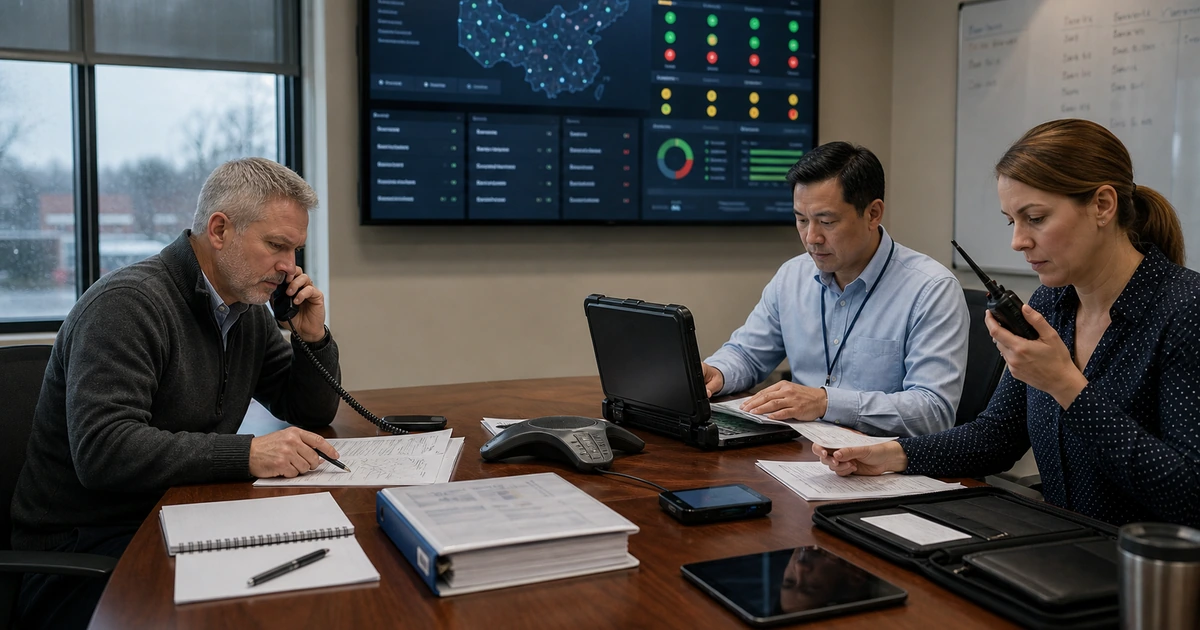
A disaster recovery readiness audit asks whether the organization can make decisions and execute under pressure, not whether a plan file exists. Recovery depends on declaration authority, available leaders, protected administrator access, accurate contacts, trusted communications, current runbooks, supplier escalation, clean equipment, tested backups, business validators, and a process for correcting failed assumptions.
Audit evidence should show what happened in the last representative test. A policy, dashboard, contract, or successful backup job supports only part of the claim. Verify that alternates can reach documentation and systems when normal identity, network, location, or devices are unavailable. Trace each restored service through security and business acceptance before reporting it ready.
ALLMSP performs recovery readiness audits and implements corrections with its in-house team for businesses in Lawrenceville, Suwanee, Gwinnett County, Metro Atlanta, and across Georgia. We can facilitate exercises, repair access and documentation gaps, test recovery, and maintain the operating record.
Audit whether people can declare, communicate, recover, validate, and improve
- Govern decisions: Verify recovery policy, service ownership, declaration thresholds, authority, alternates, risk acceptance, and reporting.
- Protect access: Test emergency identities, multifactor methods, keys, consoles, clean devices, documents, scripts, and alternate connectivity.
- Prepare communication: Maintain internal, customer, leadership, supplier, legal, insurance, and public communication paths and templates.
- Inspect runbooks: Confirm current dependencies, roles, prerequisites, steps, timing, validation, fallback, failback, and evidence requirements.
- Examine proof: Review backup coverage, job health, restore results, exercises, actual targets, capacity, deviations, and business acceptance.
- Close findings: Assign corrective owners, due dates, resources, acceptance tests, retests, residual risk, and next review.
Verify authority, alternates, emergency access, and communications under failure conditions
Review the policy and responsibility model for declaring a disaster, authorizing containment, changing recovery priorities, spending emergency funds, contacting vendors, approving customer messages, validating service, initiating failback, and closing the incident. Name primary and alternate roles rather than relying on one employee. Confirm that leaders understand the thresholds and can make decisions from available evidence. Include after-hours and travel scenarios.
Test access from a clean or alternate device and network. Verify emergency administrator identities, multifactor methods, recovery codes, password or key custody, backup console, cloud control plane, domain and DNS, virtualization, network devices, security tools, software and license sources, documentation, scripts, and vendor portals. Do not expose reusable secrets in runbooks. Make sure access survives the failure it is intended to address and that use is logged, approved, reviewed, and returned to normal control after the event.
Inspect communication plans for employees, leadership, customers, suppliers, emergency contacts, legal and insurance resources, and public channels where relevant. Maintain call trees, alternate email or messaging, telephone routing, status cadence, accessible templates, approval, and contact verification. Azure disaster recovery guidance emphasizes defined roles and communication protocols. Exercise communications when normal email, phones, identity, or office access is unavailable.
- Decision authority: Verify declaration, containment, priority, spending, vendor, communication, acceptance, failback, and closure authority.
- Role alternates: Name backups for technical, business, leadership, communication, legal, facilities, security, and vendor responsibilities.
- Emergency access: Test protected identities, authentication, keys, consoles, clean devices, alternate network, documents, and scripts.
- Communication path: Validate contacts, channels, schedules, templates, approval, accessibility, escalation, and unavailable-system alternatives.
- Vendor escalation: Confirm contract, service identifiers, contacts, severity process, authentication, entitlement, hours, and customer responsibilities.
Governance passes when authorized primary and alternate people can securely reach the resources and communication paths needed to make and execute recovery decisions.
Inspect runbooks, backup evidence, clean recovery, capacity, and business validation
Sample runbooks for critical services and compare them with current architecture. Confirm system names, dependencies, network paths, identity, certificates, keys, software, licenses, storage, backup locations, vendors, commands, scripts, contacts, and diagrams. Check prerequisites, owner per step, expected duration, failure handling, escalation, validation, fallback, failback, and evidence capture. Ask an alternate operator to follow the instructions without relying on undocumented memory.
Reconcile service dependencies with backup and replication coverage. Review last successful protection, age, size, unexpected change, retention, application consistency, isolation, encryption, deletion control, capacity, alerts, and restoration history. For cyber scenarios, confirm how the team identifies a trustworthy restore point and creates a clean recovery environment. CISA’s ransomware guide recommends protected backups and regular tests of availability and integrity in a disaster-recovery situation.
Review the last test for actual time, recovered point, data integrity, application transactions, security validation, user access, performance, capacity, communication, business acceptance, and failback. Confirm that reported results distinguish desired targets from measured results. Sample corrective actions to see whether they were completed and retested. An exercise that identifies the same inaccessible credential or stale contact every year is evidence of an unresolved governance failure.
- Runbook currency: Compare dependencies, names, accounts, networks, software, keys, vendors, steps, diagrams, and contacts with production.
- Backup evidence: Verify coverage, age, size, consistency, retention, isolation, encryption, deletion control, capacity, alerts, and restores.
- Clean recovery: Confirm containment, trusted identities, known-good software, selected restore point, security tools, and validation.
- Capacity proof: Measure compute, storage, bandwidth, licenses, users, transactions, locations, devices, and staff under recovery load.
- Business acceptance: Require named owners to execute representative transactions and record correctness, limitations, and approval.
Technical readiness passes when current runbooks and protected resources restore a secure, adequately sized service that business owners can use and accept.
Run a practical exercise, grade evidence, and maintain corrective accountability
Select a scenario that challenges meaningful assumptions without creating unmanaged production risk. A tabletop can test decisions, communications, and role knowledge. A technical restore can test data and runbooks. A functional exercise can combine alternate access, recovery steps, vendor escalation, and business transactions. State objectives, scope, participants, rules, safety controls, expected evidence, and evaluation criteria before the exercise. Use realistic injects such as unavailable staff, compromised credentials, delayed vendors, failed circuits, or an untrusted recent backup.
Grade outcomes by objective evidence. Record time to detect, escalate, declare, access tools, contain, start recovery, restore dependencies, reach the selected data point, validate security, complete business transactions, communicate, and decide failback. Note confusion, unauthorized workarounds, missing information, capacity limits, manual steps, and decisions that depended on one person. NIST recovery guidance encourages measurable recovery processes and learning from events and exercises.
Create corrective actions with severity, affected service, evidence, owner, funding or resource need, dependency, due date, acceptance test, and retest. Leadership should accept residual risk explicitly when an item will not be corrected. Update runbooks and training promptly, but do not close the finding until the changed procedure or control passes. Schedule the next exercise based on criticality, change, and prior performance. Preserve a concise audit package containing scope, plans, inventories, targets, test records, results, issues, decisions, and closure evidence.
- Exercise design: Define scenario, objectives, scope, participants, injects, safety, evidence, evaluation, and stop conditions.
- Measured timeline: Capture detection, declaration, access, containment, recovery start, restoration, validation, communication, and failback.
- Observed behavior: Record decisions, confusion, workarounds, missing data, unavailable staff, vendor delay, capacity, and manual effort.
- Corrective action: Assign service, severity, evidence, owner, resources, dependency, due date, acceptance test, and retest.
- Audit package: Preserve policy, roles, contacts, inventories, targets, runbooks, tests, results, decisions, risks, and closure proof.
Readiness improves when exercises create measurable evidence, failed assumptions become owned corrections, and closure requires a successful retest rather than an edited document.
Disaster recovery audits, exercises, and corrective support from ALLMSP
ALLMSP can audit recovery governance, roles, emergency access, communications, vendors, backup protection, runbooks, capacity, security, test evidence, and business acceptance. We can facilitate tabletop and technical exercises and preserve a clear evidence package with our in-house team.
When gaps are found, we can implement access, network, cloud, backup, identity, monitoring, documentation, and recovery corrections, then retest the affected service. The resulting program remains connected to daily support and technology change.
- Audit: Verify authority, alternates, access, communications, vendors, runbooks, protection, capacity, tests, and acceptance.
- Exercise: Challenge decisions and technical recovery with realistic scenarios, measurable timelines, and business transactions.
- Correct: Assign findings, implement controls and procedures, retest results, and maintain explicit residual-risk decisions.
Official recovery audit and exercise references
Use these sources to evaluate governance, technical recovery, and improvement, then require organization-specific evidence for every readiness statement.
- NIST contingency planning guide. Provides a structured process for impact, strategies, plans, exercises, training, and maintenance.
- NIST cybersecurity recovery guide. Covers recovery planning, playbooks, communication, metrics, improvement, and lessons from cyber events.
- CISA ransomware guide. Provides preparation and response recommendations for protected backups, communications, containment, and recovery.
- Azure disaster recovery architecture. Emphasizes roles, communication, runbooks, protected access, realistic targets, exercises, automation, and failback.
- Ready Business IT recovery planning. Connects business continuity, technology recovery priorities, data, equipment, applications, and vendor support.
Disaster recovery readiness audit FAQs
What does a disaster recovery readiness audit verify?
It verifies authority, roles, alternates, emergency access, communications, vendors, current runbooks, protected resources, capacity, restore evidence, security, business acceptance, corrective actions, and residual risk.
Why are alternate recovery roles important?
A disruption may make the primary leader, administrator, communicator, business owner, or vendor contact unavailable. Named, trained alternates reduce key-person dependency and decision delay.
What emergency access should be tested?
Test administrator identities, authentication, keys, backup and cloud consoles, domain and DNS, network devices, security tools, clean devices, alternate connectivity, documentation, scripts, and vendor portals.
What belongs in a recovery communication plan?
Include audiences, primary and alternate contacts, channels, schedules, status cadence, accessible templates, approval, escalation, customer and supplier needs, and options when normal systems are unavailable.
How can an auditor tell whether a runbook is current?
Compare it with production systems, dependencies, accounts, networks, software, keys, licenses, vendors, diagrams, and contacts, then have an alternate operator follow it during a controlled test.
What is the difference between a tabletop and a technical restore?
A tabletop examines decisions, roles, communication, and planned actions through discussion. A technical restore executes systems and data recovery. A functional exercise can combine both with business validation.
What evidence should business owners provide?
Named owners should perform representative transactions, verify data and workflow correctness, document limitations, measure minimum capacity where relevant, and explicitly accept or reject the recovered service.
When can a recovery audit finding be closed?
Close it after the approved correction is implemented and its acceptance test passes. Updating a plan or purchasing a tool is not enough when the finding concerns actual access, recovery, capacity, or behavior.
Can ALLMSP perform audits and corrections in house?
Yes. ALLMSP can audit, exercise, design, implement, document, test, monitor, and improve disaster recovery across infrastructure, cloud, backup, security, identity, networking, applications, and endpoints with its in-house team.
Where does ALLMSP provide recovery readiness audits?
ALLMSP supports businesses in Lawrenceville, Suwanee, Gwinnett County, Metro Atlanta, and throughout Georgia according to their services, technology, locations, and recovery scope.