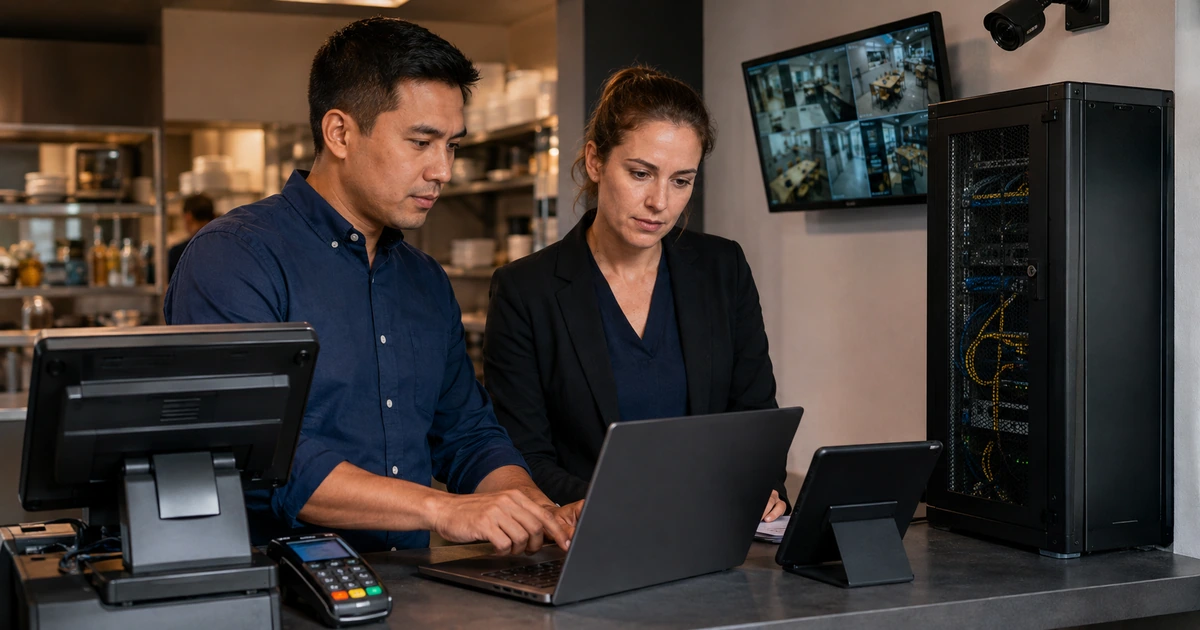
Retailers and restaurants combine public spaces, payment devices, high employee turnover, shared work areas, guest networks, vendor-managed systems, cameras, online ordering, cloud applications, and time-sensitive operations. That mix creates security questions that a generic office checklist will miss. An effective audit must follow how a real employee, customer transaction, device, vendor, and location move through the environment.
The review should identify which systems can affect payment data, who can administer them, how remote access works, where credentials are shared, whether networks are truly separated, how devices are inspected, what evidence is logged, and whether backups can restore an operating workflow. PCI DSS provides a baseline for entities that store, process, transmit, or can affect payment account data, but the business must still understand its exact architecture and responsibilities.
ALLMSP conducts and implements retail and restaurant security improvements through its in-house team for organizations in Lawrenceville, Suwanee, Gwinnett County, Metro Atlanta, and throughout Georgia. We connect technical findings to locations, transactions, employees, vendors, recovery steps, and accountable business decisions.
Audit the paths that can reach transactions and operations
- Define scope: Map locations, payment flows, systems, networks, cloud services, integrations, vendors, data, people, and physical access.
- Reconcile identities: Review owners, administrators, managers, employees, service accounts, shared credentials, vendor users, and stale access.
- Verify boundaries: Test payment, business, guest, camera, building, wireless, remote-access, and management network separation.
- Inspect endpoints: Check approved devices, versions, agents, encryption, tamper evidence, configuration, storage, logging, and retirement.
- Test evidence: Confirm that access, changes, transactions, security events, backups, and incidents create useful protected records.
- Exercise recovery: Restore representative systems and data, rehearse incident decisions, validate fallback work, and reconcile transactions.
Map payment scope, network paths, vendors, and physical exposure
Document payment acceptance from card presentation or online checkout through terminal, application, network, processor, gateway, integration, settlement, reporting, refunds, and stored records. Identify every system that stores, processes, transmits, or can affect account data. Include point-of-sale servers, workstations, readers, ecommerce platforms, network devices, wireless systems, remote support, management consoles, logging, backups, and vendor connections. Confirm current PCI validation expectations with the acquiring bank, processor, qualified assessor when needed, and applicable service providers.
Create and verify network diagrams for each location and the shared cloud environment. Trace allowed communication between payment, business, guest, camera, voice, building, employee, and management networks. Test whether a guest, camera, smart device, or ordinary employee endpoint can reach a payment address or management interface. Review firewall rules, switch configuration, wireless SSIDs, VPNs, direct internet exposure, remote desktop paths, vendor appliances, cellular gateways, and temporary connections. Remove rules that have no current owner or business justification.
Inspect the physical environment during operating hours. Look for terminal substitution or tampering, exposed network ports, unlocked cabinets, visible passwords, shared keys, unattended tablets, public access to cables, cameras that expose sensitive work, unprotected back-office equipment, discarded reports, and devices moved without authorization. Compare payment terminal models and serial numbers with inventory and inspection records. Define who inspects each device, what indicators to look for, how often, and what employees must do when something appears wrong.
- Payment map: Record capture, processing, transmission, storage, administration, integration, reporting, refund, settlement, and disposal.
- Network proof: Test routes, rules, ports, wireless access, management paths, vendor connections, direct exposure, and segmentation controls.
- Service-provider record: Track responsibility, access, data, compliance evidence, incident notice, retention, subcontractors, support, and termination.
- Terminal inspection: Verify model, serial, placement, seals, cables, overlays, damage, unexpected devices, configuration, and employee escalation.
- Physical boundary: Review cabinets, ports, keys, screens, tablets, printers, reports, storage, cameras, disposal, and visitor access.
A defensible scope is based on verified transaction and access paths, not assumptions about which device looks like the payment system.
Review accounts, remote support, endpoints, updates, and daily controls
Inventory identities across point-of-sale, payment, email, file storage, scheduling, inventory, ordering, delivery, loyalty, cameras, networks, remote support, ecommerce, analytics, and vendor portals. Replace shared administrative credentials with named accounts where supported. Confirm each user, role, location scope, privilege, MFA method, recovery path, last activity, owner, and employment or contract status. Remove former employees, stale vendors, duplicate owners, excessive manager rights, and emergency access that has become permanent.
Review remote access as a privileged service. Identify agents, VPNs, vendor tools, built-in utilities, browser extensions, tunnels, and direct protocols. Require an approved business purpose, named identity, strong MFA, limited device scope, logging, monitoring, current software, and prompt removal. Connect support sessions to a ticket or documented maintenance event. Investigate portable tools, unexpected agents, sessions outside expected hours, broad device browsing, disabled logs, large transfers, and repeated authentication failures.
Evaluate endpoint and change controls. Confirm supported operating systems, point-of-sale and peripheral software, security agents, encryption where appropriate, secure configurations, firmware, vulnerability response, application allowlisting where suitable, backups, time synchronization, and tamper protection. Changes should have an owner, reason, affected locations, risk, maintenance window, configuration backup, test, rollback, communication, and result. Train employees to protect credentials, inspect payment devices, reject unexpected support requests, report suspicious activity, and avoid connecting personal equipment to production systems.
- Identity review: Match every account to a person or service, owner, role, locations, privilege, MFA, recovery, activity, and lifecycle state.
- Remote-access review: Inventory tools, users, devices, authentication, exposure, sessions, logs, updates, vendors, exceptions, and removal.
- Endpoint baseline: Check support status, configuration, security controls, encryption, agents, firmware, applications, logs, backup, and retirement.
- Change control: Require request, approval, backup, schedule, test, rollback, documentation, communication, and post-change observation.
- Employee practice: Train credential safety, device inspection, support verification, suspicious-event reporting, safe network use, and escalation.
Security becomes practical when identity, device, support, and change records match the people and equipment actually operating at each location.
Prove logging, backups, incident response, and business recovery
Confirm that important systems produce useful records and that those records are protected. Collect authentication, administrative change, remote-support, endpoint, firewall, wireless, payment, ecommerce, backup, and security alerts with consistent time. Define retention, access, review, export, and escalation. Test whether an investigator can answer who accessed a system, from where, through which method, what changed, which transactions or locations were affected, and whether the activity continued elsewhere.
Review backups by restore, not by a green status badge. Inventory configurations and business data required to recover point-of-sale support systems, inventory, office files, application exports, network devices, cameras where required, ecommerce content, and documentation. Protect backup administration with separate credentials and MFA. Maintain copies that a compromised production administrator cannot silently erase where practical. Restore selected data and configurations into a controlled environment, measure time, verify integrity, and document dependencies that must be rebuilt rather than restored.
Run a tabletop exercise around a realistic event such as stolen credentials, malicious remote access, payment terminal tampering, ransomware in the back office, ecommerce compromise, or a vendor breach. Identify who stops transactions, isolates systems, preserves evidence, contacts payment parties, communicates with locations, invokes manual operations, restores service, validates security, and reconciles transactions. CISA’s ransomware guidance emphasizes preparation, containment, evidence, recovery, and reporting. Adapt the plan to contracts, cyber insurance, legal obligations, card-brand and processor requirements, and law enforcement guidance.
- Log test: Reconstruct identity, source, target, method, time, action, change, location, transaction context, alert, and response.
- Backup inventory: List data, configuration, owner, source, destination, schedule, retention, protection, dependency, test, and recovery target.
- Restore test: Recover representative records and configurations, validate integrity, measure time, document gaps, and assign corrections.
- Incident exercise: Practice authority, isolation, evidence, payment coordination, location communication, continuity, recovery, and reconciliation.
- Remediation record: Prioritize finding, affected scope, risk, owner, correction, due date, evidence, retest, exception, and final decision.
An audit is complete only when the organization can detect meaningful activity, recover essential operations, and prove that identified weaknesses were corrected.
Retail and restaurant security assessment and remediation from ALLMSP
ALLMSP can map payment and network scope, inventory accounts and remote tools, inspect locations, test segmentation, review endpoints, strengthen access, improve logging, verify backups, lead incident exercises, implement remediation, and provide ongoing managed security. Our in-house team performs the technical work and coordinates directly with the customer’s authorized payment and business contacts.
We serve retailers and restaurants in Lawrenceville, Suwanee, Gwinnett County, Metro Atlanta, and throughout Georgia. The review can focus on a specific payment or access concern or cover the complete multi-location environment.
- Assess: Map transactions, networks, vendors, identities, remote access, endpoints, physical controls, logs, backups, and response.
- Remediate: Correct access, segmentation, configurations, updates, monitoring, backup protection, procedures, training, and documentation.
- Maintain: Review changes, inspect devices, test controls, manage lifecycle work, monitor events, support incidents, and report evidence.
Official payment and incident-readiness references
These references support technical planning but do not replace current payment, contractual, insurance, regulatory, legal, or qualified-assessor requirements.
- PCI Data Security Standard. Provides the current baseline of technical and operational payment-account data security requirements.
- PCI SSC maintaining payment security. Summarizes merchant practices for secure networks, access, monitoring, testing, and employee awareness.
- CISA StopRansomware Guide. Provides preparation, prevention, response, evidence, and recovery guidance for ransomware incidents.
- CISA multifactor authentication guidance. Recommends stronger authentication for email, remote access, storage, and administrative systems.
Retail and restaurant cybersecurity audit FAQs
What should a retail cybersecurity audit include?
Include payment flows, networks, wireless service, cloud platforms, devices, identities, vendors, remote access, physical controls, logs, backups, incident response, and remediation evidence.
Does every point-of-sale terminal have the same PCI DSS scope?
No. Scope depends on device type, configuration, connections, data handling, surrounding systems, service providers, and the organization’s verified cardholder data environment.
How is network segmentation verified?
Test actual routes and access between payment, business, guest, camera, device, wireless, remote, and management networks instead of relying only on configuration names.
Why are shared manager accounts a security problem?
Shared identities weaken accountability, offboarding, least privilege, MFA, incident investigation, and the ability to connect an action to one authorized person.
What should payment-terminal inspections look for?
Verify model, serial number, placement, seals, cables, overlays, unexpected attachments, damage, configuration, inventory match, and employee reporting steps.
How should point-of-sale vendors access systems remotely?
Use approved named accounts, strong MFA, limited scope, current tools, business authorization, ticket linkage, logging, monitoring, time boundaries, and prompt removal.
What logs matter during a retail security incident?
Preserve identity, remote access, endpoint, firewall, wireless, payment, ecommerce, administrative change, security alert, backup, and relevant physical-access records.
How often should backups be tested?
Use a risk-based schedule tied to change and recovery needs, with representative restores, integrity checks, measured timing, documented dependencies, and assigned corrections.
Can ALLMSP implement the audit findings?
Yes. ALLMSP assesses and remediates accounts, networks, devices, remote support, monitoring, backups, procedures, and training through its in-house team.
Where does ALLMSP conduct retail security reviews?
ALLMSP supports Lawrenceville, Suwanee, Gwinnett County, Metro Atlanta, and organizations across Georgia with coordinated onsite and remote work.