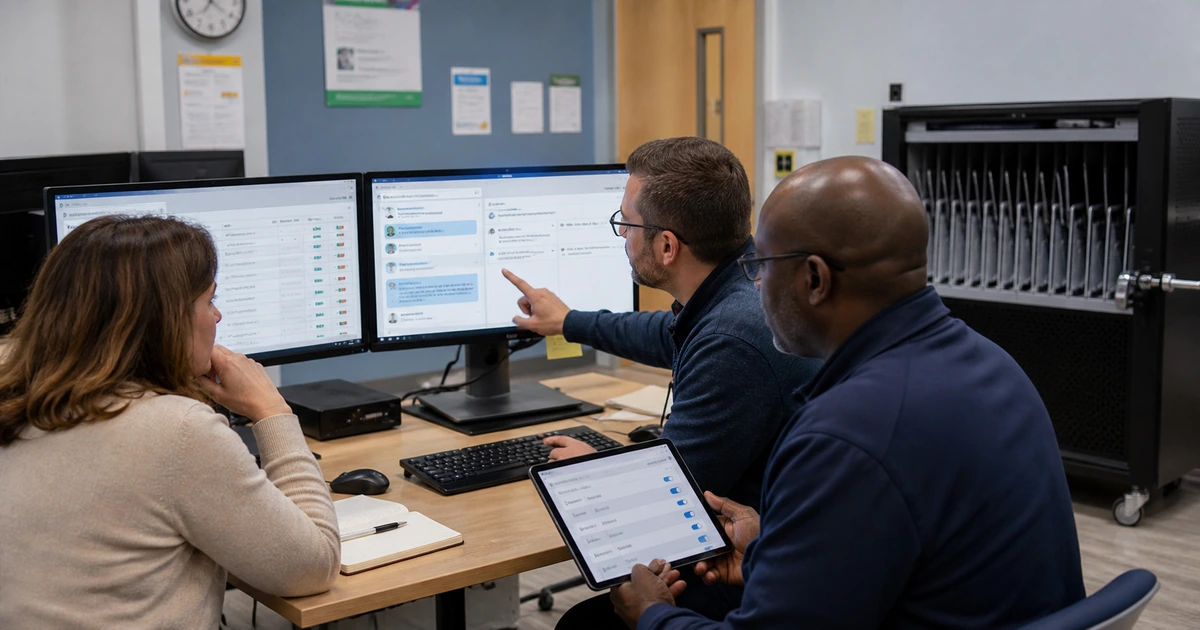
An AI pilot should answer a business question, not simply prove that a tool can generate text. Local governments need to know whether a proposed workflow improves a real public service without weakening privacy, accessibility, records management, security, accuracy, or employee accountability. A small controlled pilot creates that evidence before the agency commits to broad access or a costly integration.
Choose a task with enough volume to measure and low enough consequence to review safely. Strong pilot candidates include organizing non-sensitive requests, drafting routine material from approved sources, summarizing internal guidance, or preparing a first-pass classification that an authorized employee verifies. Avoid beginning with automated eligibility, enforcement, hiring, discipline, emergency decisions, or unrestricted access to resident records.
ALLMSP designs and operates AI pilots for public-service teams in Lawrenceville, Suwanee, Gwinnett County, Metro Atlanta, and across Georgia. We configure the environment, protect accounts and data, build test cases, train participants, measure results, correct problems, and support the workflow through a go, revise, or stop decision.
A controlled government AI pilot from idea to decision
- Write the pilot charter: Define the task, users, approved sources, expected output, prohibited actions, success measures, duration, owner, and decision that the evidence must support.
- Build a secure sandbox: Use managed identities, limited permissions, sample or minimized data, logging, retention controls, and a separate environment where mistakes cannot trigger agency action.
- Recruit realistic users: Include heavy users, occasional users, mobile staff, accessibility needs, unusual permissions, multilingual requests, and employees who know the difficult exceptions.
- Test ordinary and hard cases: Compare expected results with output for routine work, incomplete inputs, conflicting policy, sensitive content, service outages, and attempts to exceed the approved purpose.
- Measure the full workload: Count preparation, review, corrections, escalations, training, support, and monitoring rather than reporting generation time alone.
- Make an evidence-based decision: Expand only when the agency can explain the benefit, remaining risk, operating cost, ownership, controls, support model, and conditions that would trigger reevaluation.
Design the pilot around one measurable service outcome
Write the current baseline before configuring the AI tool. Measure request volume, completion time, staff effort, correction rate, backlog, resident follow-up, and existing support demand. If the team cannot describe the current process, a faster demonstration will not show whether the pilot actually helped.
Limit the first release to a named group and a narrow body of approved information. Participants should know which account to use, what may be entered, which outputs require review, where results are saved, how to report a problem, and how to complete the task when the AI service is unavailable.
- Pilot question: Frame a decision such as whether AI can reduce first-pass sorting time while keeping misrouting below an agreed threshold and preserving required review.
- Baseline: Collect enough pre-pilot examples to understand normal variation, peak demand, recurring exceptions, and the real cost of the manual process.
- Scope boundary: List included departments, records, features, integrations, locations, users, and devices along with everything that remains outside the test.
- Decision rights: Name the sponsor, program owner, technical owner, records contact, security reviewer, accessibility reviewer, support lead, and person authorized to stop the pilot.
- Exit criteria: Define the minimum quality, maximum risk, support burden, cost, adoption, and recovery results required for continuation.
A pilot charter keeps the team focused on a public-service outcome when vendor demonstrations and new features compete for attention.
Create a safe environment and a demanding test set
Use the least sensitive information that can still prove the concept. Synthetic, redacted, or approved sample data can reveal workflow behavior before production records are introduced. Restrict connectors, downloads, sharing, model training, and administrative privileges according to the pilot charter, then verify the restrictions with tests and logs.
Friendly examples hide the failures that reach the help desk. Include vague requests, duplicate submissions, attachments in unexpected formats, outdated source material, conflicting instructions, accessibility scenarios, translation needs, adversarial prompts, and cases that must be rejected or escalated. Reviewers should write the expected handling before seeing the AI response.
- Identity control: Require managed accounts, multifactor authentication, role-based access, separate administrative credentials, and a documented process for adding or removing participants.
- Data control: Verify input limits, retention, export, deletion, regional processing, model-training settings, subprocessors, and the treatment of uploaded files.
- Action control: Prevent the pilot from sending public messages, changing records, approving requests, or initiating transactions without an authorized human checkpoint.
- Failure testing: Test unavailable integrations, expired credentials, malformed files, prompt injection, unsupported claims, low confidence, and loss of the primary service.
- Evidence capture: Record test case, expected result, actual result, reviewer, correction, severity, system version, and disposition so decisions can be reproduced.
The pilot is valuable when it exposes limits early and leaves a record of how the agency responded to them.
Train participants and measure whether the workflow deserves expansion
Training should use the agency’s actual pilot tasks. Participants need to practice recognizing an unsupported answer, protecting information, editing output, citing the approved source, handling an accessibility concern, reporting an incident, and switching to the fallback process. A short quiz or observed exercise can confirm that the rule is understood.
Review results by case type and user group, not just as one average. A workflow might save time for common requests while failing on multilingual submissions or creating more work for records staff. Include support tickets, overrides, resident complaints, employee confidence, and the time spent verifying output in the final evaluation.
- Quality: Track factual accuracy, complete handling, correct routing, source support, consistent treatment, accessibility, and the seriousness of each correction.
- Efficiency: Measure total staff time from intake through review and closure, including preparation, rework, escalation, support, and documentation.
- Adoption: Observe whether users follow the approved process, avoid prohibited inputs, understand uncertainty, and report problems without hiding workarounds.
- Operations: Confirm monitoring, account administration, version changes, backup or export, incident response, vendor support, and ownership after the pilot team disbands.
- Decision record: Document why the agency will expand, revise, pause, or end the pilot and identify the specific evidence behind that choice.
A successful pilot ends with an operating decision and a controlled next step, not an open-ended promise that employees should explore the technology.
ALLMSP government AI pilot services
ALLMSP can turn a proposed use case into a controlled pilot with a charter, secure environment, test set, employee training, support process, measurement plan, and final decision record. We also connect the pilot to identity, cybersecurity, records, networking, line-of-business software, and managed support so the test reflects the environment where it would operate.
Our Lawrenceville-based team serves Suwanee, Gwinnett County, Metro Atlanta, and public organizations throughout Georgia. Every phase is handled in house, from technical discovery through configuration, launch support, evidence review, and the production rollout when the results justify it.
- Pilot planning: Use-case selection, baseline, risk review, charter, participant profile, test design, and success thresholds.
- Technical controls: Managed accounts, data boundaries, connector restrictions, logging, retention, monitoring, and tested fallback procedures.
- Evaluation: Participant training, quality review, support analysis, outcome measurement, remediation, and a documented release decision.
Primary resources for public-sector AI pilots
These sources provide practical risk and testing concepts that can be adapted to the agency’s authority, data, policy, and service obligations.
- ALLMSP AI Readiness Services. Local use-case assessment, data review, roadmap development, and pilot preparation.
Government AI pilot frequently asked questions
What is a good first AI pilot for a government office?
Choose a frequent, reviewable, low-consequence task with an available baseline and approved information. Examples can include organizing non-sensitive requests, drafting routine material from current guidance, or preparing a first-pass classification that an authorized employee verifies.
How long should a local government AI pilot run?
Run it long enough to include normal demand, peak periods, difficult exceptions, different user types, support events, and at least one controlled failure exercise. The calendar matters less than collecting enough representative evidence to make the defined decision.
Should production records be used during the first test?
Begin with synthetic, redacted, or approved sample information whenever it can prove the workflow. Introduce production data only after the agency has verified the account, contract, retention, access, logging, integration, records, and security controls required for that information.
Who should participate in a government AI pilot?
Include the program owner, frontline users, IT, security, records, accessibility, legal or policy reviewers, support staff, and users who encounter unusual cases. A friendly group of light users rarely reveals operational limits.
What metrics show whether an AI pilot worked?
Measure complete task time, factual quality, correction severity, routing accuracy, review effort, support demand, user compliance, accessibility, privacy or security events, cost, resident impact, and performance during exceptions.
How should employees be trained for an AI pilot?
Use real pilot exercises that cover approved inputs, prohibited data, source checking, human approval, accessibility, uncertainty, error reporting, incident response, and the non-AI fallback. Confirm understanding through observed practice rather than attendance alone.
What should stop an AI pilot immediately?
Pause the workflow when it exposes protected information, produces a serious harmful result, acts beyond authorization, loses required logs, cannot be controlled administratively, creates an accessibility barrier, or behaves outside the approved purpose.
Can a pilot connect directly to government systems?
Only when the integration is necessary for the test and its permissions, data flow, actions, logging, failure behavior, credentials, and removal process have been reviewed. Read-only or isolated connections are often appropriate before write access is considered.
Does ALLMSP provide training and ongoing support after the pilot?
Yes. ALLMSP configures the platform, secures the environment, trains each user role, supports participants, reviews pilot evidence, corrects the workflow, documents administration, and provides ongoing managed support when the agency moves forward.
Which Georgia communities can ALLMSP support with AI pilots?
ALLMSP supports government teams in Lawrenceville, Suwanee, Gwinnett County, Metro Atlanta, and across Georgia. Engagements can cover one small experiment, a department workflow, or a coordinated agency program.
Sources
- NIST AI Resource Center. Tools and guidance for applying the AI Risk Management Framework and evaluating AI systems. ↩
- NIST AI RMF Core. Outcomes for governing, mapping, measuring, and managing AI risk throughout the lifecycle. ↩
- CISA Secure by Design. Principles that can inform technology selection and safe default expectations. ↩