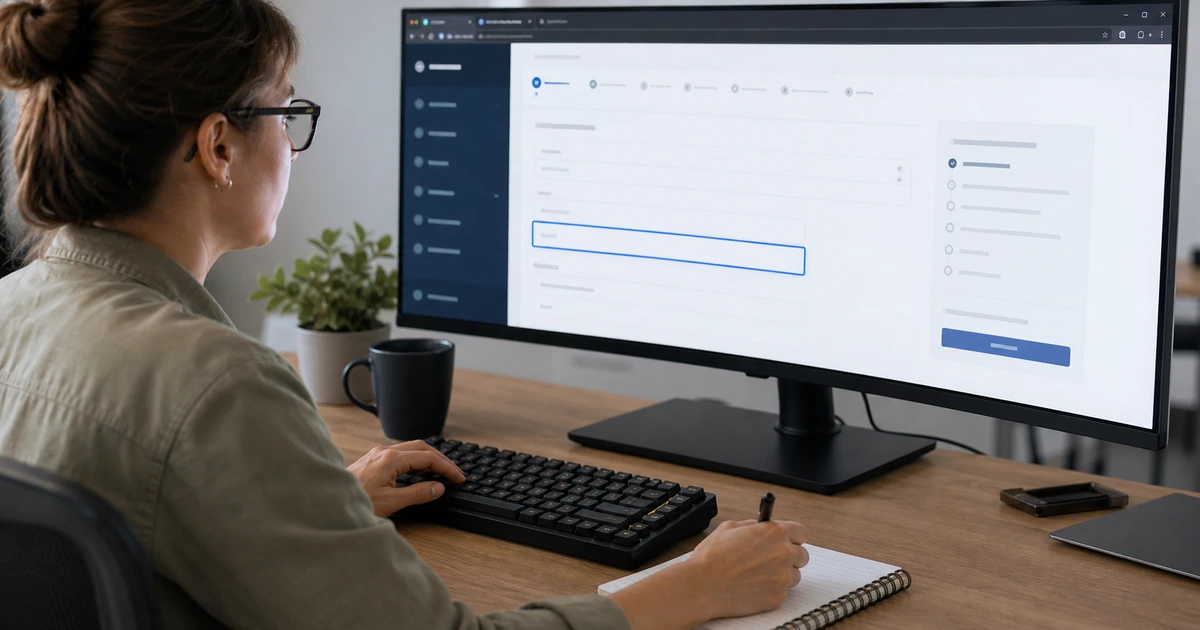
A website audit should explain where customers get stuck, which pages fail to answer important questions, whether search engines can discover and understand the content, and whether valuable actions reach the business. A score without page-level evidence does not tell an owner what to fix. The audit needs to connect technical findings, customer behavior, search demand, lead quality, and the operating process behind the site.
Begin with the site’s intended outcomes and real customer journeys. A visitor may arrive from a local result, advertisement, referral, product page, article, or direct search for a service. Follow each journey from entry page through decision information, proof, conversion action, confirmation, and staff response. Review desktop and mobile behavior separately. The resulting roadmap should rank corrections by customer impact, revenue or service value, risk, reach, confidence, effort, and dependencies.
ALLMSP audits and improves websites for organizations in Lawrenceville, Suwanee, Gwinnett County, Metro Atlanta, and throughout Georgia. Our in-house team can correct content, design, accessibility, technical SEO, analytics, forms, hosting, security, integrations, and lead routing, then validate the result with real evidence instead of handing the business a generic report.
Build an evidence-backed website improvement backlog
- Confirm goals: Define valuable customer actions, lead quality, service priorities, locations, audiences, and business constraints.
- Inventory pages: Map live URLs, templates, ownership, purpose, traffic, queries, links, conversion paths, update age, and technical state.
- Observe journeys: Test how representative visitors find information, compare options, establish trust, complete actions, and receive follow-up.
- Validate systems: Check crawlability, indexing, canonicals, schema, speed, responsive behavior, accessibility, forms, tracking, and integrations.
- Rank findings: Prioritize by customer harm, missed opportunity, security or compliance risk, recurrence, reach, confidence, effort, and dependency.
- Measure changes: Capture a baseline, release corrections in controlled groups, verify behavior, and compare meaningful outcomes.
Combine page inventory, search data, analytics, lead records, and direct testing
Create a crawlable inventory of public pages, important files, redirects, status codes, canonical targets, titles, descriptions, headings, structured data, images, internal links, and indexability. Add each page’s intended audience, purpose, owner, primary action, service, location relevance, last substantive review, and replacement plan. Identify duplicate or near-duplicate pages, orphaned content, outdated claims, broken links, thin service descriptions, accidental indexing, and valuable old URLs that need preservation.
Use Google Search Console to understand which queries and pages already earn impressions and clicks, where mobile and desktop results differ, and whether indexing or enhancement issues exist. Use analytics to trace landing pages, engagement, useful events, paths, and device patterns. Reconcile those systems with call logs, form submissions, CRM records, appointment outcomes, and sales feedback. A page with modest traffic may still be valuable if it produces qualified opportunities, while a high-traffic article may need a better path to relevant services.
Perform direct tests with realistic tasks. Ask someone unfamiliar with the site to find a specific service, determine whether the company serves their area, compare options, locate proof, call from a phone, and submit a form with both valid and invalid entries. Test keyboard navigation, zoom, screen sizes, slower connections, browser variations, and blocked third-party scripts. Record the expected result, observed result, evidence, severity, affected pages, and proposed correction. Google advises creating helpful, reliable content for an intended audience, so judge whether each page actually enables a reader to accomplish its purpose.
- Content evidence: Review accuracy, originality, depth, readability, ownership, search intent, local context, proof, and update needs.
- Search evidence: Compare queries, impressions, clicks, positions, indexing, canonicals, internal links, sitemaps, and search enhancements.
- Behavior evidence: Examine landing pages, device patterns, paths, useful events, abandonments, errors, and confirmed conversions.
- Business evidence: Reconcile calls, forms, appointments, opportunities, lead quality, response time, service fit, and common questions.
- Observed tests: Document representative tasks, expected behavior, actual behavior, screenshots or logs, severity, and affected audiences.
The audit becomes useful when every important finding has a page, customer consequence, supporting evidence, responsible owner, and testable correction.
Correct clarity, information architecture, mobile usability, forms, and trust
Fix the path before polishing individual components. Simplify navigation around the services and decisions customers understand. Give each page a specific role and remove dead ends. Use descriptive page titles, headings, links, and calls to action. Place the most decision-relevant information early while preserving enough context for complex services. Connect broad service pages to useful subservices, industries, products, examples, and practical articles. Link supporting pages back to the appropriate commercial next step.
Rewrite content that relies on empty superlatives, keyword repetition, internal project notes, or vague lists. Replace it with concrete information about work performed, outcomes, process, fit, prerequisites, choices, safeguards, support, and evidence. Add original photographs or authentic interface images only when they help the customer inspect the service or product. Keep important text in HTML rather than embedding it inside graphics. Verify that headings remain proportional and that one item on a mobile row is centered instead of stranded to one side.
Reduce friction in contact paths. Keep the requested information appropriate to the next step, explain why sensitive details are needed, label every field, preserve valid entries after an error, and state what happens after submission. Make phone links visible and functional on mobile. Confirm that forms deliver to monitored destinations and create the expected CRM or ticket records. Add trustworthy evidence near the decision, such as relevant certifications, authentic reviews, service coverage, project examples, security practices, response expectations, and clear company identity. Avoid badges or claims the business cannot substantiate.
- Navigation: Organize choices around customer language, limit competing paths, expose important pages, and eliminate unclear labels.
- Content: Replace generic claims with service scope, process, fit, proof, safeguards, outcomes, and useful answers.
- Mobile layout: Correct overlap, overflow, off-center single items, cramped buttons, oversized whitespace, and unreadable imagery.
- Forms and calls: Simplify inputs, label controls, validate errors, verify delivery, provide confirmation, and preserve alternate contact options.
- Trust: Present accurate company identity, relevant credentials, authentic proof, service coverage, policies, and realistic expectations.
A correction is successful when it removes a documented barrier from a real customer journey and still works across devices, input methods, and lead-delivery systems.
Prioritize releases, protect search equity, and prove business improvement
Score the backlog consistently. Urgent items include broken contact paths, misleading information, security exposure, inaccessible primary actions, indexing failures, accidental noindex rules, damaging redirects, and severe mobile defects. High-value improvements may include missing priority service pages, unclear offers, weak proof, poor local relevance, slow templates, or unmeasured conversions. Group changes that depend on the same template, data source, integration, or approval so releases remain understandable and testable.
Protect existing search value during structural changes. Record the old and new URL, content purpose, canonical, internal links, sitemap state, redirect, and validation result. Do not redirect unrelated pages to a generic destination merely to avoid a 404. Update internal links to the final URL. Check that important pages remain indexable and that staging controls did not reach production. After release, inspect key URLs in Search Console and monitor crawl, indexing, traffic, and query changes over a suitable period without reacting to ordinary daily variation.
Measure outcomes that reflect the site’s purpose. Compare qualified conversions, completion rate, call quality, form errors, page engagement, mobile performance, search visibility for relevant queries, support questions, and response time. Annotate release dates and preserve the previous state when practical. If a metric moves, investigate channel mix, seasonality, campaign changes, tracking integrity, and lead handling before crediting the design. Maintain an improvement log with decision, owner, release, expected outcome, acceptance test, observed result, and next action.
- Immediate repairs: Resolve broken leads, false claims, security issues, blocked pages, harmful redirects, and unusable primary actions.
- High-value improvements: Strengthen priority service content, customer paths, local context, proof, mobile performance, and measurement.
- Controlled release: Use staging, backups, approvals, test cases, change records, rollback steps, and focused production validation.
- Search protection: Preserve useful URLs, map permanent redirects, update internal links, validate canonicals, and monitor indexing.
- Outcome review: Compare qualified leads, errors, speed, visibility, user behavior, and support evidence against the documented baseline.
The roadmap is complete when the business can see why each change matters, what was released, how it was tested, and whether customers and staff experienced a measurable improvement.
Website audits and measurable improvement from ALLMSP
ALLMSP can audit content, search visibility, responsive design, accessibility, speed, forms, analytics, hosting, security, integrations, and lead operations as one system. We turn findings into a prioritized roadmap and complete the approved corrections with our in-house team.
After release, we validate the customer path, technical result, search transition, and lead delivery. Ongoing reporting focuses on evidence the business can act on, including qualified opportunities, recurring questions, visibility, errors, performance, and the next highest-value improvement.
- Audit: Combine technical inspection, direct customer journeys, search data, analytics, and lead records.
- Correct: Improve page structure, content, mobile usability, accessibility, conversion paths, tracking, security, and operations.
- Verify: Test releases, protect URLs, confirm lead delivery, compare outcomes, and maintain an accountable improvement log.
Official website audit and improvement references
Use these sources to support specific checks, then interpret their findings in the context of the business, customer journey, technology, and measurement quality.
- Google SEO Starter Guide. Provides search fundamentals for useful content, page organization, crawlability, links, and images.
- Google Search Console introduction. Explains reports used to monitor search performance, indexing, and site enhancements.
- Google people-first content guidance. Offers practical questions for judging whether content gives its audience a satisfying result.
- Core Web Vitals. Defines field metrics for loading, responsiveness, and visual stability.
- W3C form labels. Explains how visible, associated labels make forms more understandable and operable.
Business website audit FAQs
What should a professional website audit include?
It should cover business goals, customer journeys, content, search visibility, indexing, information architecture, mobile behavior, accessibility, performance, forms, calls, analytics, lead delivery, security, hosting, backups, ownership, and measurable priorities.
Why is a website score not enough?
A score can summarize one tool’s rules but may not show which customers are affected, whether a lead was lost, how the issue connects to business value, or what correction should be tested first.
Which data sources help explain website performance?
Use Search Console, analytics, call and form records, CRM outcomes, sales feedback, support questions, site crawls, performance data, accessibility tests, direct observation, and documented business priorities.
How should website improvements be prioritized?
Prioritize customer harm, missed opportunity, security or compliance risk, affected traffic and pages, recurrence, confidence in the evidence, implementation effort, dependencies, and the ability to verify the result.
Should low-traffic pages be removed?
Not automatically. A low-traffic page may serve a valuable niche service, customer support need, sales process, or important search query. Review purpose, quality, conversions, links, freshness, and alternatives before consolidating or retiring it.
How can a website audit improve local SEO?
It can clarify services and areas served, correct inconsistent business information, strengthen useful local context, improve internal links and technical access, and identify whether local visitors can understand and act on the offer.
What should be tested after a form is changed?
Test labels, required states, validation, keyboard use, mobile inputs, spam controls, consent, confirmation, notifications, CRM or ticket creation, source attribution, duplicate events, privacy, and monitored ownership.
How are URL changes handled safely?
Maintain a URL register, preserve addresses where practical, map each changed page to the closest relevant destination, apply one-hop permanent redirects, update internal links and canonicals, and test live responses.
Can ALLMSP implement the recommendations from its audit?
Yes. ALLMSP can complete content, design, development, accessibility, SEO, analytics, hosting, security, integration, and lead-routing improvements with its in-house team.
Where does ALLMSP provide website audits?
ALLMSP audits and improves business websites in Lawrenceville, Suwanee, Gwinnett County, Metro Atlanta, and throughout Georgia according to site complexity and business goals.