

















































































































































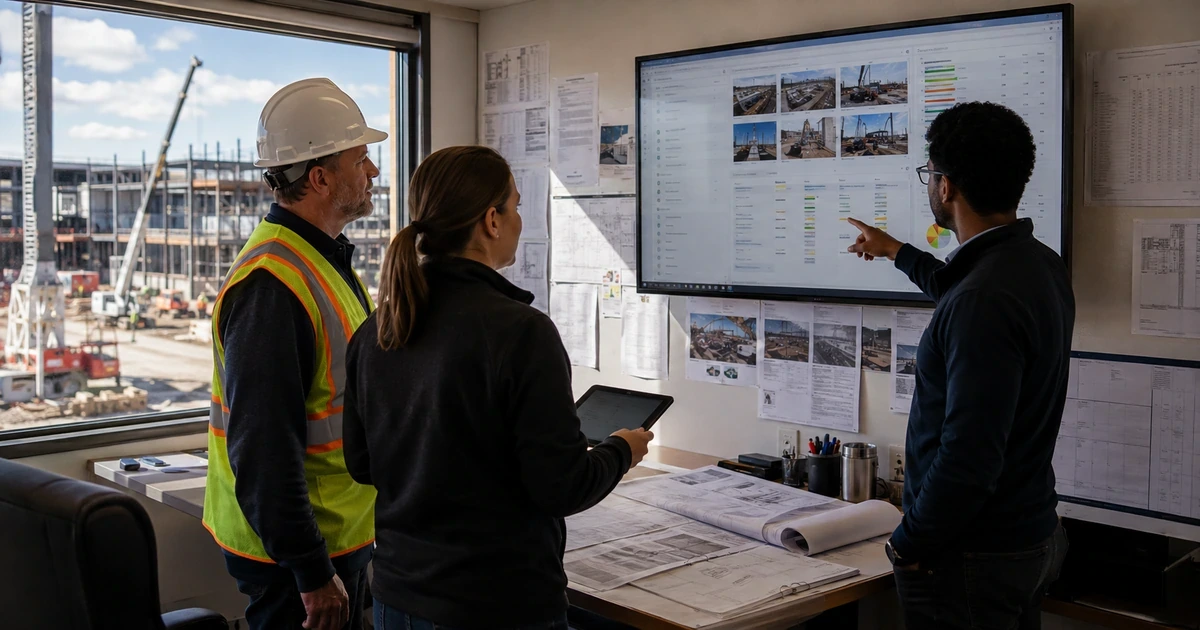
A useful construction AI pilot begins with a specific operational decision, not a broad promise to make the company smarter. The strongest candidates are repeated workflows with enough reliable evidence to test a result, such as finding current project information, sorting field photos, drafting routine summaries, identifying incomplete records, routing requests, or highlighting items that need qualified human review.
Construction data is difficult because context lives across drawings, specifications, RFIs, submittals, schedules, daily logs, change records, cost systems, email, photos, equipment records, and conversations. A model cannot reliably distinguish current information from superseded information unless the surrounding system preserves versions, status, ownership, permissions, and the relationship between a record and the project decision it supports.
ALLMSP helps general contractors, specialty contractors, home builders, and field-service organizations in Lawrenceville, Suwanee, Gwinnett County, Metro Atlanta, and throughout Georgia prepare for AI. Our in-house team can improve project data, integrations, identity, cloud services, mobile access, security, backup, workflow design, testing, documentation, training, and ongoing support from the first assessment through daily operation.
A practical readiness path for construction AI
- Choose one measurable problem: Name the task, user, project stage, expected output, current effort, consequence of error, and business result before selecting a tool.
- Map the complete record: Trace the workflow through project platforms, accounting, email, file storage, mobile devices, photos, forms, integrations, and manual handoffs.
- Establish authoritative sources: Identify which drawing, specification, schedule, cost record, contact, and approval state controls the next action.
- Improve data quality: Correct missing identifiers, inconsistent naming, weak metadata, duplicate records, outdated templates, and unrecorded exceptions that would mislead automation.
- Set security boundaries: Limit the data, projects, users, connected systems, service accounts, exports, and provider retention available to the pilot.
- Define acceptance evidence: Create representative test cases, baseline performance, human review rules, fallback steps, and a decision date for expand, revise, or stop.
Map the field and office workflow before selecting an AI tool
Observe the work where it occurs. Follow a representative item from the first request through final use, including the person who creates it, the systems it enters, every transformation, each approval, field access, customer or subcontractor communication, accounting impact, closeout, and retention. Capture workarounds such as text messages, personal folders, copied spreadsheets, handwritten notes, and screenshots because those paths often contain the context missing from the official platform.
Define what a correct outcome means at each handoff. An RFI summary is useful only if it points to the current question, response, drawing, responsible party, due date, and affected work. A photo classification is useful only if the image belongs to the right project, location, date, trade, activity, and permission context. A forecast is useful only when source costs, commitments, changes, progress, exclusions, and confidence are visible to the project leader who must act.
- Project identity: Standardize project numbers, names, phases, locations, companies, contracts, cost codes, work breakdown, and archive status across connected systems.
- Document control: Preserve version, revision, status, discipline, location, distribution, approval, superseded state, and links between drawings, specifications, RFIs, submittals, and changes.
- Field evidence: Connect daily logs, observations, inspections, photos, quantities, deliveries, equipment, weather, labor, and corrective actions to the work they describe.
- Commercial context: Separate estimates, budgets, commitments, invoices, changes, forecasts, payments, and final costs while documenting the approval needed for each transition.
- People and access: Use named identities, current companies, project roles, managed devices, multifactor authentication, expiration, and prompt removal when work ends.
- Exception paths: Record how teams handle missing information, disputed status, offline work, poor connectivity, urgent field conditions, rejected approvals, and system outages.
A workflow map gives the pilot a real operating boundary and prevents an attractive demo from being mistaken for a dependable construction process.
Prepare connected data without exposing every project record
Build the smallest trustworthy dataset that can answer the pilot question. Include ordinary work, difficult cases, incomplete inputs, changed conditions, different project types, and known failures. Keep a protected evaluation set separate from configuration and prompt changes. Remove stale copies and document exclusions instead of silently cleaning away the cases that the field team will encounter after launch.
Review the technical path from source to model and back. Document connectors, exports, APIs, service accounts, synchronization timing, field mappings, transformations, file limits, provider processing, retention, regional storage, logs, and failure alerts. Decide whether output is displayed as a suggestion, written to a draft location, routed for approval, or allowed to change another system. Early pilots should favor reversible actions and visible human confirmation.
- Data dictionary: Define important fields, allowed values, units, status meanings, relationships, ownership, sensitivity, and the action each value may support.
- Quality checks: Measure missing required fields, duplicates, invalid dates, orphaned records, inconsistent cost codes, outdated contacts, broken links, and contradictory status.
- Source permissions: Grant access only to approved projects, folders, tables, mailboxes, calendars, photos, and financial records required for the chosen use case.
- Provider controls: Review account ownership, training use, retention, deletion, subprocessors, administrative access, export, audit evidence, and contract terms.
- Integration safeguards: Protect secrets, restrict service accounts, validate field mappings, log requests and responses, detect failed synchronization, and provide a controlled retry path.
- Recovery plan: Preserve original records, version configuration, back up supporting systems, test rollback, and define how staff continue work when the AI feature is unavailable.
Readiness does not require perfect data. It requires enough documented quality, context, access control, and recovery to understand what the pilot can and cannot prove.
Run a construction AI pilot against real edge cases
Select users who represent the conditions the final workflow must survive. Include a project manager with heavy document volume, a superintendent working from a mobile device, an estimator handling incomplete requests, an accounting user responsible for cost accuracy, and an administrator who can inspect logs and permissions. Friendly sample accounts rarely expose offline behavior, unusual project roles, large files, changed drawings, or the historical workarounds that create support demand.
Compare the pilot with the current process using the same cases. Track time, completeness, correction effort, unsupported statements, missed exceptions, user confidence, support tickets, security events, and downstream results. Review every high-consequence output with the qualified person who owns the decision. Expansion should depend on evidence that the system improves useful work without hiding new risk or shifting cleanup to another team.
- Reference cases: Build a test set with current and superseded documents, incomplete field notes, duplicate photos, unusual permissions, changed scope, and known integration failures.
- Baseline: Measure the existing time, error rate, rework, search effort, response delay, and review burden before changing the workflow.
- Human review: Name who verifies factual support, project status, safety relevance, contractual meaning, cost impact, customer communication, and final approval.
- Failure behavior: Test unavailable sources, ambiguous requests, missing context, malicious instructions, low confidence, provider outage, and loss of connectivity.
- Adoption evidence: Observe whether users understand the output, recognize limitations, follow the review step, report problems, and return to the approved fallback when needed.
- Decision record: Document results, unresolved risks, configuration changes, training needs, operating cost, ownership, and the reason to expand, revise, pause, or retire the pilot.
A successful pilot produces a verified operating decision and reusable evidence, not only a promising demonstration.
Construction AI readiness and implementation with ALLMSP
ALLMSP can assess project and field workflows, identify practical AI opportunities, improve data and integrations, configure approved platforms, secure identities, create evaluation cases, implement human review, document fallback procedures, train users, and operate the finished system. We connect AI work with managed IT, cybersecurity, cloud, mobile devices, backup, construction software, and user support instead of treating the model as an isolated project.
Contractors in Lawrenceville, Suwanee, Gwinnett County, Metro Atlanta, and across Georgia can begin with one high-value workflow or a broader readiness roadmap. Every engagement stays tied to measurable field and office work, accountable owners, protected project information, and evidence that leadership can use for the next investment decision.
- Readiness assessment: Use cases, process map, authoritative data, project systems, integrations, devices, access, security, backup, risks, effort, and prioritized roadmap.
- Pilot implementation: Approved platform, controlled dataset, connectors, prompts or rules, evaluation cases, human review, monitoring, documentation, training, and fallback.
- Ongoing improvement: Support, access review, provider changes, quality checks, incident response, performance measurement, workflow refinement, and expansion decisions.
Primary resources for construction AI readiness
Use current AI risk and construction technology guidance, then apply it to the contractor’s own projects, contracts, data, users, systems, and operating consequences.
- NIST AI Risk Management Framework. A voluntary framework for incorporating trustworthiness into AI design, use, evaluation, and risk management.
- Autodesk construction AI overview. An industry overview of connected project data, embedded workflows, human review, and practical construction AI capabilities.
- CISA secure AI system development guidance. Secure-by-design considerations across AI design, development, deployment, and operation.
- ALLMSP AI Readiness Assessment and Roadmap. Local AI opportunity, data, workflow, infrastructure, security, and implementation planning.
Construction AI readiness FAQs
What is a good first AI use case for a construction company?
Choose a repeated, measurable, low-consequence workflow with reliable source data and clear human ownership. Examples include finding current project records, drafting routine summaries, sorting photos, checking required fields, or routing items for review.
Does construction data need to be perfect before an AI pilot?
No. The organization should understand quality, provenance, version, status, permissions, missing information, and known limitations well enough to create a controlled dataset and judge results accurately.
Which construction records may support an AI workflow?
Relevant sources may include drawings, specifications, RFIs, submittals, schedules, daily logs, inspections, photos, cost records, change documentation, equipment information, customer requests, and approved communications.
How should contractors protect project data used by AI?
Use managed accounts, least privilege, project boundaries, multifactor authentication, protected secrets, provider retention controls, approved integrations, audit logs, access review, and verified deletion or export procedures.
Why are authoritative records important for construction AI?
AI can produce a polished answer from an outdated drawing or superseded schedule. The workflow must preserve revision, status, approval, relationship, and ownership so users can verify the current controlling source.
Who should participate in a construction AI pilot?
Include the people who perform, review, support, and depend on the workflow, including field and office users with high volume, unusual permissions, mobile constraints, complex projects, and known edge cases.
What should a construction AI pilot measure?
Measure time, completeness, correction effort, unsupported statements, missed exceptions, rework, user understanding, support demand, security events, operating cost, and the downstream result tied to the business goal.
Should AI be allowed to approve construction decisions automatically?
Begin with suggestions, drafts, classification, or routing. Qualified people should retain approval for safety, contract, design, cost, schedule, employment, payment, customer, and other consequential decisions.
Can ALLMSP implement the complete construction AI solution in house?
Yes. ALLMSP handles readiness, workflow design, data, integrations, cloud, identity, cybersecurity, testing, documentation, training, monitoring, user support, and ongoing improvement in house.
Where does ALLMSP provide construction AI services?
ALLMSP serves contractors and construction organizations in Lawrenceville, Suwanee, Gwinnett County, Metro Atlanta, and throughout Georgia with local and remote technical delivery.