

























































































































































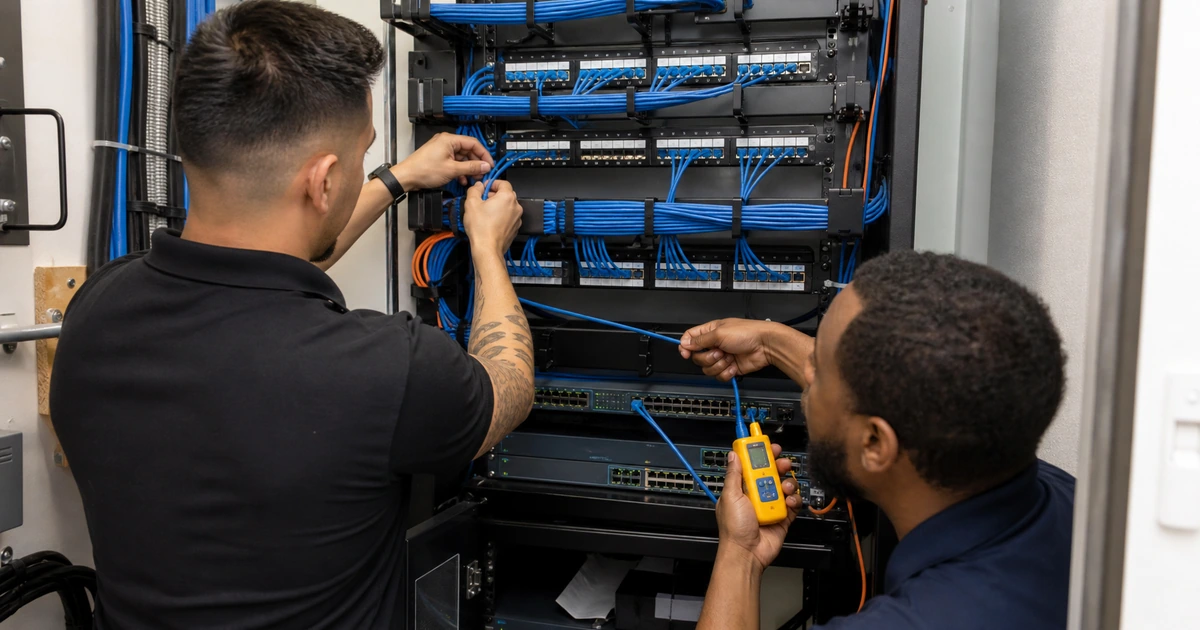
A crowded network closet is not merely untidy. Unidentified patch cords, blocked airflow, unsupported equipment, undocumented switch ports, damaged connectors, overloaded power, and abandoned cabling can turn a simple move or outage into hours of uncertain work. Cleanup should improve reliability and serviceability without disconnecting a phone, access point, camera, workstation, printer, point-of-sale device, or business system by mistake.
The safest approach begins with discovery and evidence. Technicians trace links, record active services, photograph existing conditions, identify equipment and power dependencies, and plan changes in small reversible stages. Cable appearance matters, but function, bend radius, strain relief, separation, grounding, firestopping, labeling, test results, airflow, access, and documentation matter more.
ALLMSP performs network cabling cleanup and remediation in house for businesses in Lawrenceville, Suwanee, Gwinnett County, Metro Atlanta, and throughout Georgia. We can trace copper and fiber, reorganize racks and patching, correct terminations, test links, coordinate switches and power, label infrastructure, document ports, and schedule changes around business operations.
Turn an uncertain network closet into a tested and maintainable system
- Record conditions: Photograph racks, pathways, panels, switches, power, grounding, fiber, patching, labels, damage, airflow, and access.
- Trace services: Map outlets, devices, patch-panel positions, switch ports, VLANs, PoE needs, uplinks, circuits, owners, and criticality.
- Plan safely: Group changes by risk, define maintenance windows, preserve rollback, coordinate users, and protect critical operations.
- Rebuild patching: Use suitable cord lengths, cable management, bend control, strain relief, port visibility, airflow, and service loops.
- Test the result: Validate physical links, negotiated speed, PoE, VLAN, addressing, application reachability, phones, wireless, and monitoring.
- Maintain records: Update labels, port maps, rack elevations, photographs, change logs, spares, ownership, and future capacity.
Discover active services before moving a single patch cord
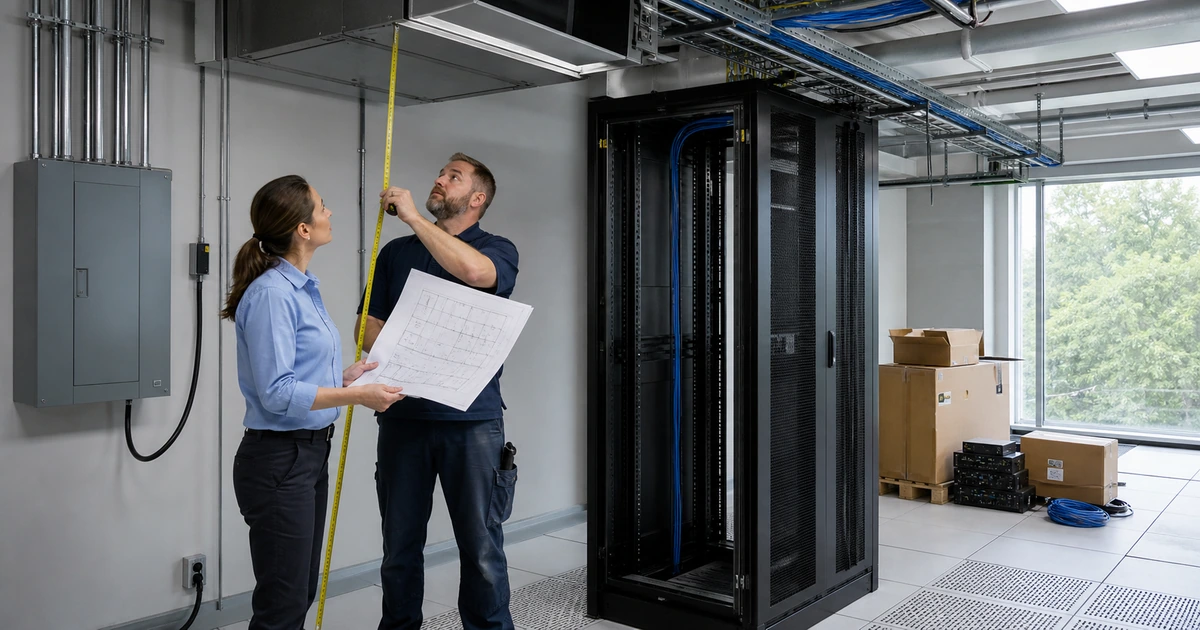
Begin with safety and access. Identify the room owner, authorized technicians, maintenance window, emergency contacts, alarm or access procedures, electrical panels, uninterruptible power supplies, grounding, cooling, water exposure, ceiling conditions, ladders, and obstacles. Confirm which work requires a qualified low-voltage, electrical, firestopping, building, or safety professional. Photograph each rack, cabinet, wall field, pathway, panel, switch, power device, and cable bundle from several angles before changing anything.
Inventory active and inactive infrastructure. Record rack units, equipment model and serial number, management address, switch stack, uplinks, modules, power source, warranty, support state, and owner. Map each patch-panel position to its switch port and connected outlet or device. Capture VLAN, negotiated speed, PoE class or draw where available, link state, traffic, MAC address, and business purpose. Include voice, Wi-Fi, cameras, access control, printers, point of sale, conference rooms, building systems, servers, and carrier handoffs.
Trace uncertainty deliberately. Use switch data, tone and probe tools, cable identifiers, link lights, endpoint observation, and approved disconnect tests to reconcile labels. Do not assume an inactive-looking port is abandoned because it may support a device that sleeps, a backup circuit, a seasonal station, or an emergency system. Mark confidence and unresolved findings. Compare outlet labels with drawings and business-owner knowledge. Create a no-touch list for critical links until a controlled window and rollback path exist.
- Condition record: Capture room, racks, pathways, panels, power, cooling, grounding, firestopping, access, hazards, and existing damage.
- Equipment map: Record device, rack position, management, uplink, switch relationship, power, support, owner, and critical function.
- Port map: Connect outlet, panel, switch port, VLAN, speed, PoE, endpoint, user or area, business purpose, and confidence.
- Critical link: Flag carrier, firewall, server, uplink, phone, safety, camera, access-control, point-of-sale, and production dependencies.
- Unknown status: Document evidence, trace attempts, likely purpose, risk, next test, owner, and date instead of guessing.
A cleanup becomes controlled engineering when the team knows what each connection supports and which business consequence follows an interruption.
Reorganize racks and patching in small reversible change stages
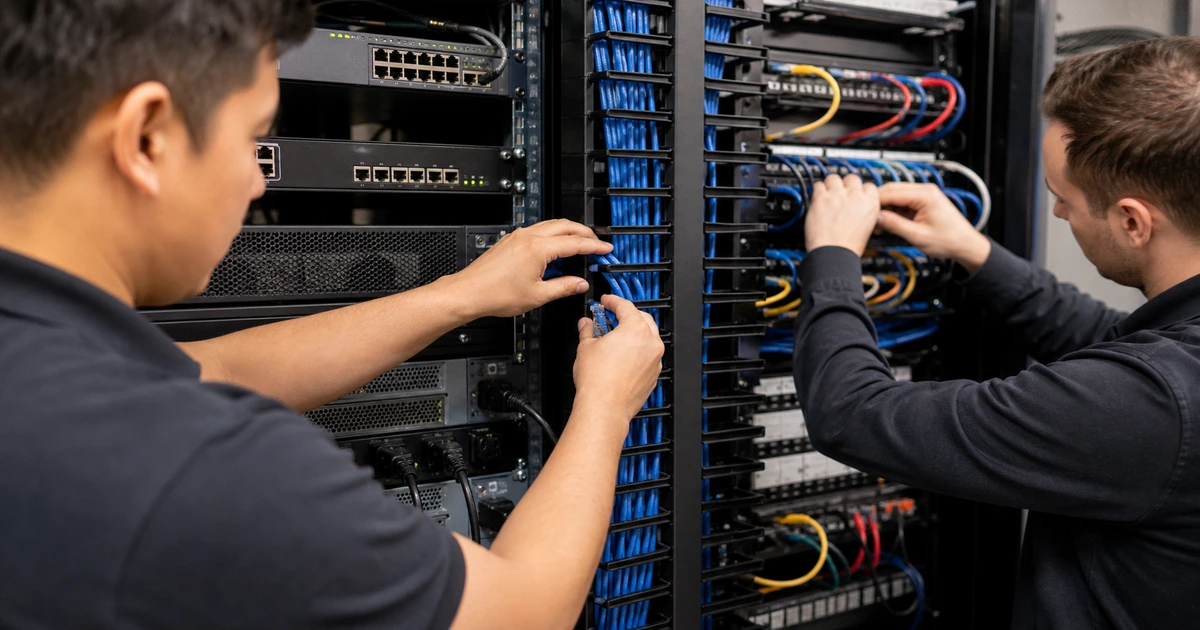
Create a target rack and patching plan before pulling cords. Decide equipment positions, horizontal and vertical management, fiber protection, copper routing, uplink separation, service loops, airflow, power-cord paths, panel visibility, spare ports, growth space, and access for maintenance. Use patch cords that are suitable for the cabling system and long enough to route without tension. Avoid tight bends, crushed bundles, unsupported weight, blocked vents, and cords stretched across equipment faces.
Divide work into change groups such as one panel, switch, department, floor, or service at a time. Record the before state, intended after state, affected users, expected interruption, validation steps, and rollback. Move and test one group before proceeding. Maintain out-of-band communication and access to switch configuration, backups, carrier contacts, and spare materials. Do not remove an apparently abandoned cable until its status, ownership, code implications, and appropriate disposition are established.
Correct underlying defects discovered during cleanup. Replace damaged patch cords, repair or reterminate poor connections, secure panels and managers, protect fiber connectors, remove inappropriate strain, and address unsupported equipment. Coordinate power work with qualified personnel. Preserve separation and pathway requirements appropriate to the environment. Restore firestopping where penetrations are affected through approved methods. A visually neat rack is not acceptable if cleanup hides failed terminations or violates installation requirements.
- Target layout: Plan equipment, panels, cable managers, fiber, uplinks, power, airflow, visibility, spare space, and service access.
- Change group: Limit scope, identify affected services, schedule downtime, record positions, test results, and maintain rollback.
- Patch quality: Use suitable cords, supported routing, bend control, strain relief, clear port access, and maintainable service loops.
- Defect correction: Repair damaged cords, connectors, panels, fiber protection, supports, labels, and other verified physical problems.
- Removal control: Confirm abandonment, ownership, pathway, fire rating, safety, disposal, and documentation before cable removal.
Small reversible stages protect uptime and make it possible to identify exactly which change caused a problem if validation fails.
Validate applications and leave records that simplify every future change
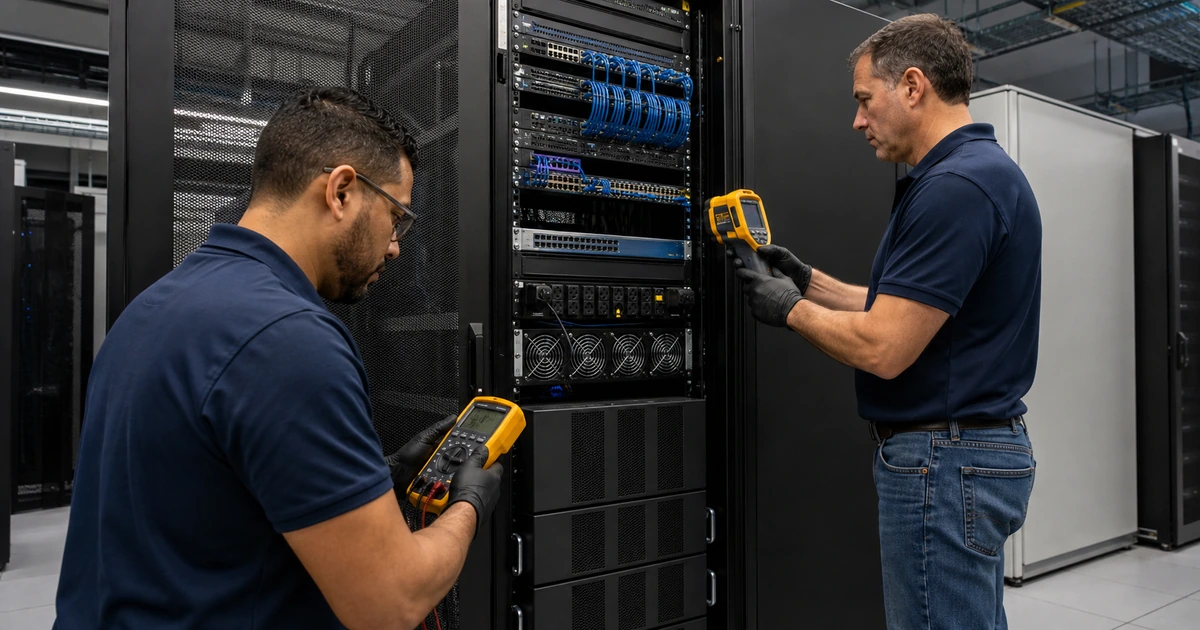
Test more than link lights. Confirm physical connection, speed and duplex, error counters, PoE delivery, VLAN, network addressing, authentication, name resolution, internet or internal reachability, and the application the endpoint serves. Place test calls, roam on wireless, view approved cameras, print, process a test transaction, or exercise the relevant workflow. Monitor switch events and help desk reports during and after the change window. Correct unexpected negotiation, errors, flapping, or power behavior before closure.
Where permanent cabling was repaired or its performance is uncertain, use appropriate field testing and preserve the result by cable identifier. Distinguish a continuity or wiremap check from qualification or standards-based certification. Test parameters and limits should match the specified cable category, link configuration, connectors, application, contract, and current applicable standards. TIA announced ANSI/TIA-568.2-E in 2024 as the updated balanced twisted-pair cabling and components standard. Project requirements should cite the exact current edition rather than a remembered category label.
Complete documentation while the work is still visible. Update outlet and panel labels, switch-port descriptions, VLAN assignments, device records, rack elevation, pathway notes, photographs, test reports, spare materials, and capacity. Use a consistent identifier that connects the physical label to the record. Record every later move, addition, and change. Review closet condition, temperature, power, access, cable management, documentation accuracy, spare capacity, and unsupported equipment on a schedule.
- Physical validation: Check wiremap or fiber continuity as appropriate, link state, negotiated rate, errors, stability, and PoE delivery.
- Service validation: Test addressing, VLAN, authentication, DNS, phone, wireless, camera, printer, transaction, and application workflows.
- Certification record: Store cable ID, test standard, link type, limit, instrument, calibration, date, operator, result, and retest.
- Administration record: Connect outlet, pathway, panel, rack, switch, port, service, VLAN, device, owner, test, and change history.
- Maintenance review: Inspect access, heat, power, grounding, damage, dust, labeling, patching, capacity, alerts, and documentation drift.
The finished closet should let a qualified technician understand and change the environment without repeating the entire discovery project.
Network closet and cabling cleanup from ALLMSP
ALLMSP can survey facilities, trace links, document active services, plan maintenance windows, reorganize racks, replace patch cords, correct terminations, test copper and fiber, coordinate switches and PoE, update labels, and deliver useful records through our in-house technical team.
We provide network cabling and cleanup services in Lawrenceville, Suwanee, Gwinnett County, Metro Atlanta, and throughout Georgia. Work can support an office move, unreliable network, acquisition, switch replacement, wireless upgrade, phone deployment, camera project, compliance review, or long-overdue documentation effort.
- Trace: Identify racks, panels, switch ports, outlets, devices, services, owners, dependencies, and unknowns.
- Remediate: Organize patching, repair physical defects, protect fiber and copper, preserve uptime, and manage each change.
- Document: Validate business services and deliver labels, maps, photographs, test results, capacity, and change records.
Official structured cabling and Ethernet references
Use current project specifications, manufacturer instructions, applicable codes, and qualified professionals. Standards evolve, so confirm the exact edition and test limits required for the facility and contract.
- TIA-568 commercial cabling standards. Provides the TIA standards family for commercial building telecommunications cabling.
- TIA announcement for ANSI/TIA-568.2-E. Identifies the 2024 balanced twisted-pair cabling and components standard revision.
- TIA telecommunications administration work. Describes current standards activity for telecommunications infrastructure identification and administration.
- IEEE 802.3 Ethernet Working Group. Maintains the standards work that defines Ethernet technologies and active projects.
- BICSI field-testing reference. Includes field-testing requirements for installed balanced copper, optical fiber, and other cabling.
Network cabling cleanup FAQs
Why is a messy network closet a reliability problem?
It can hide damaged cords, unknown dependencies, blocked airflow, inaccessible ports, power problems, undocumented services, and changes that are difficult to test or reverse.
Can all unused-looking cables be removed during cleanup?
No. Confirm activity, ownership, purpose, pathway, applicable requirements, and disposition first. Sleeping devices, backup links, and seasonal systems may appear inactive.
How can cabling cleanup avoid outages?
Trace first, define critical links, work in small groups, schedule appropriate windows, record before states, maintain rollback, and validate each service before proceeding.
What should a network port map include?
Connect the outlet, patch panel, switch port, VLAN, speed, PoE, endpoint, location, user or service, owner, test result, and change history.
Should patch cords all be the same length?
No. Use suitable lengths that route through cable management without tension, sharp bends, blocked access, excessive bundles, or unnecessary slack.
Is a link light enough to prove a cable works?
No. Validate negotiated speed, errors, stability, PoE, VLAN, addressing, and the actual phone, wireless, camera, printer, transaction, or application workflow.
When should permanent cabling be certified?
Follow project, contract, warranty, application, and current standards requirements. Certification is especially useful for new work, repaired links, upgrades, and disputed performance.
What records should remain after cleanup?
Keep labels, port maps, rack elevations, device records, photographs, test reports, pathway notes, VLANs, spare capacity, owners, exceptions, and change logs.
Can ALLMSP coordinate cabling with network equipment changes?
Yes. ALLMSP can handle tracing, rack work, terminations, testing, switch and PoE coordination, configuration, documentation, and application validation in house.
Where does ALLMSP provide network cabling cleanup?
ALLMSP serves Lawrenceville, Suwanee, Gwinnett County, Metro Atlanta, and organizations across Georgia with planned onsite cabling work.