
A Stripe integration can pass a checkout demo and still fail at launch. Test objects do not exist in live mode, the live webhook endpoint has a different signing secret, a retry without idempotency can create a second operation, or a Dashboard setting can diverge from the assumptions in code. Retail and restaurant teams then discover the gap during a lunch rush, online promotion, subscription renewal, or end-of-day close when the cost of experimentation is highest.
The useful architecture is an evidence chain from business intent to Stripe request, Stripe object, event, internal record, and financial result. It defines which environment is authoritative for each stage, where secrets live, how object identifiers are promoted, which API version shapes responses, what a safe retry means, how webhook work is deduplicated, and which logs prove the outcome. That chain also gives support teams a way to separate a customer-facing payment state from an integration-delivery problem.
This guide turns those concerns into a test-to-live operating model for Georgia retailers and restaurants. Pair it with ALLMSP’s [Stripe software resource center](https://www.allmsp.com/category/software-support/software-support-stripe/), [Retail and Restaurants guidance](https://www.allmsp.com/category/retail-and-restaurants/), and broader [Software Support](https://www.allmsp.com/category/software-support/) coverage. Use the current Stripe documentation for the exact product, account, API namespace, and payment method in your implementation.
Key decisions at a glance
- Give every Stripe environment its own configuration inventory, object identifiers, API keys, webhook destinations, signing secrets, test evidence, and accountable owner.
- Prefer an isolated Stripe Sandbox for substantial changes, and document any test-mode setting that can still influence live behavior before touching it.
- Attach a stable idempotency key to each logical write operation, retain the operation-to-key mapping through retries, and reject parameter drift.
- Verify webhook signatures from the unmodified request body, acknowledge deliveries quickly, and process business work through a durable idempotent queue.
- Promote Stripe changes through a launch gate that proves configuration parity, observability, rollback readiness, reconciliation, and operational ownership.
Define Environment Boundaries Before You Build

Start with a Stripe environment register. For development, quality assurance, staging, and production, record the Stripe account or Sandbox, account identifier, mode, owners, permitted users, integration repository and release, secret-store path, publishable-key location, webhook destinations, signing-secret references, API version policy, connected applications, products and prices, tax and payment settings, and downstream systems. Record references to credentials rather than the values themselves. The register should make an accidental cross-environment dependency visible before a payment request is sent.
Stripe currently recommends Sandboxes for testing because they provide isolated settings and granular access. Test mode remains available, but Stripe warns that some Dashboard changes made while viewing test data can affect live settings unless the interface explicitly indicates otherwise. That difference matters during configuration reviews. A Sandbox intended to mirror production should be created for a named purpose, assigned to the smallest team that needs it, and compared with live mode through a deliberate configuration checklist rather than assumed to be an exact clone forever.
Do not copy opaque object IDs from test into production configuration. Products, Prices, Customers, Coupons, webhook destinations, and other Stripe objects belong to the environment that created them. Promote definitions, not identifiers: maintain a manifest with stable internal aliases, create or select the corresponding live objects through an approved process, and bind the resulting live IDs in production configuration. Validate currency, amount, tax behavior, statement description, payment methods, receipt behavior, fulfillment metadata, and refund policy with a low-risk live transaction before broad release.
- Keep sandbox, test-mode, and live account identifiers visually distinct in configuration, monitoring, runbooks, and deployment approvals.
- Inventory which Dashboard settings are isolated, copied, or potentially shared before changing anything while test data is displayed.
- Map internal catalog aliases to environment-specific Stripe object IDs instead of embedding test identifiers in application code.
- Use synthetic identities and Stripe test values in testing, never import real card details or unnecessary customer data into a test environment.
Control Keys, Versions, and Integration Configuration
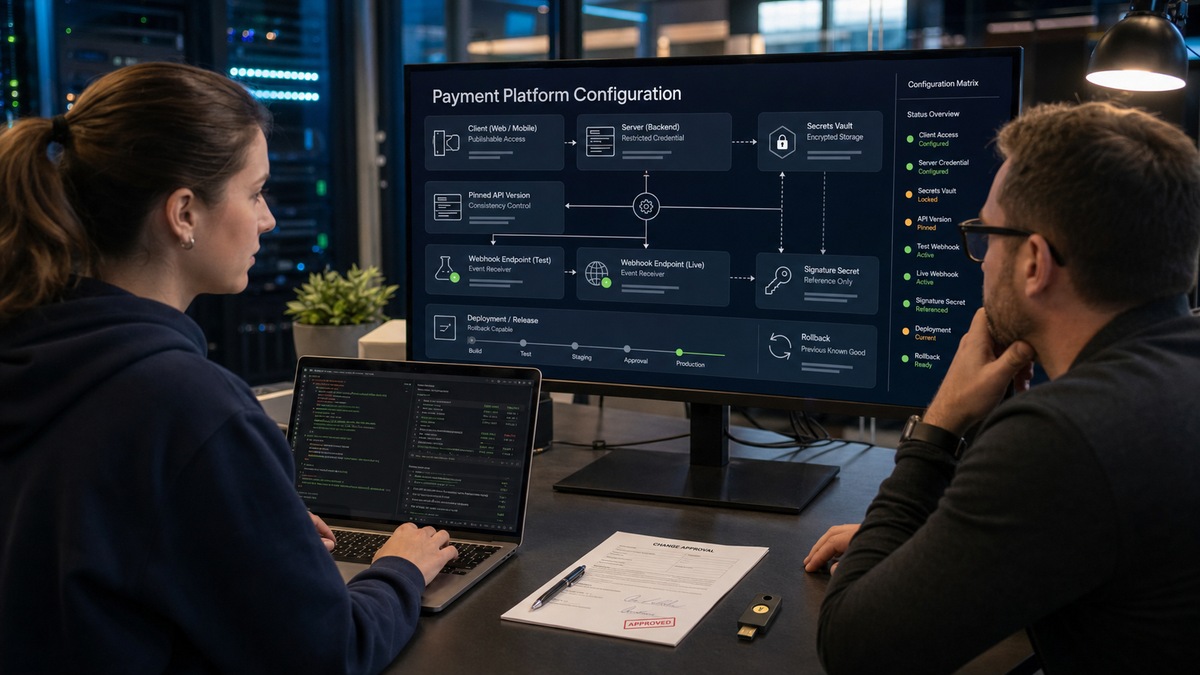
Stripe publishable keys belong in client-side payment collection, secret and restricted keys remain server-side. Keep each live secret in an approved secrets manager, inject it at runtime, and log only a key name or internal fingerprint that cannot authenticate. Create separate credentials for independent services so a checkout, reconciliation job, dispute monitor, and vendor connector do not share one unrestricted key. A restricted key should receive only the resource permissions and, where practical, source IPs needed for its workload.
Build a configuration matrix around more than the API key. Include the Stripe account and mode, API version, webhook destination ID, subscribed event set, webhook signing-secret reference, return URLs, internal queue, timeout and retry policy, currency, Connect context if used, and owning service. Validate the matrix at process startup without printing secrets. A production deployment should fail closed when a test key prefix, test account, unexpected endpoint, or missing signing secret is detected rather than silently attempting a payment in the wrong context.
Pin the Stripe API version intentionally and treat an upgrade as a schema change. Review Stripe’s versioning and webhook-versioning guidance, update the official SDK, exercise representative success and failure paths in a Sandbox, compare request and response fields, and test deserialization of webhook payloads. Record the prior version and rollback procedure. Avoid changing the account default, endpoint version, application release, and event subscriptions in one unobservable step because the resulting fault will not have a clean boundary.
- Separate browser publishable keys, server credentials, restricted job keys, and webhook signing secrets by purpose and environment.
- Store secrets outside source control, deployment logs, tickets, screenshots, exported environment files, and shared team chat.
- Pin and record the API version used by direct requests and each event destination, test version changes against captured contract cases.
- Make environment validation part of startup and deployment health checks, while emitting only non-secret configuration evidence.
Make API Writes and Webhook Processing Safe to Repeat
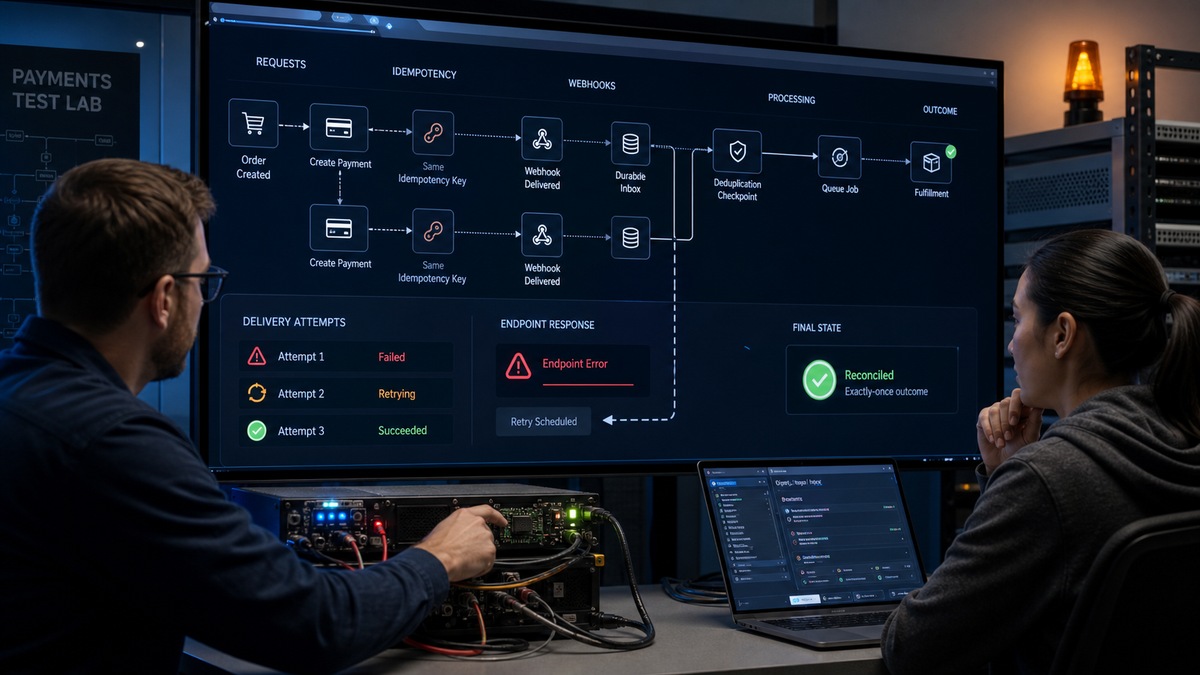
A network timeout does not tell the caller whether Stripe completed a write. For each logical create or update operation, generate a stable idempotency key tied to the internal order, reservation, invoice, or refund command. Persist that key before the first call, send the same parameters when retrying, and store the Stripe request ID and resulting object ID. Never reuse one key for a different business action. Stripe’s idempotency layer can return the result associated with the original request, which is exactly why the key must represent one immutable operation.
Webhook delivery is a notification channel, not the only ledger of truth. Verify the Stripe-Signature header with the endpoint’s signing secret and the raw, unmodified request body. After verification, record the Stripe event ID, account context, livemode value, event type, object ID, API version, received time, and processing state in a durable inbox. Return a successful response before expensive downstream work, then let a queue perform an idempotent state transition. Duplicate or out-of-order events should produce a safe no-op or a fresh object retrieval, not a second fulfillment.
Test failure behavior deliberately. Force a request timeout after submission, deliver the same event more than once, deliver a later event before an earlier one, disable a dependency, return a non-success response from the endpoint, and rotate a signing secret. Use Workbench to correlate API request logs, event payloads, and delivery attempts. Acceptance requires correct customer state, inventory or reservation state, internal ledger entries, and Stripe financial objects,not merely a green HTTP response.
- Derive idempotency keys from a durable operation record and preserve the key-to-parameters-to-result relationship for support evidence.
- Reject a retry when its normalized parameters differ from the original command, and route the discrepancy for human review.
- Verify signatures before parsing business fields, preserve the raw body, and keep test and live endpoint secrets separate.
- Deduplicate by Stripe event ID while making the underlying business transition independently idempotent and order-aware.
Promote Through a Launch Gate and Recoverable Change Process
Create a Stripe launch packet that a business owner, developer, support lead, and finance owner can all evaluate. It should show the approved catalog mapping, live account and endpoint identifiers, credential references, roles, two-step authentication status, API and webhook versions, subscribed events, payment-method tests, idempotency evidence, signature tests, failure simulations, monitoring thresholds, settlement and refund checks, customer messaging, support contacts, and rollback actions. Stripe’s go-live checklist is a starting point, your packet connects it to the exact retail or restaurant workflow being released.
Release in a controlled window with named decision makers and objective stop conditions. Watch payment success and decline patterns, latency, HTTP and Stripe error classes, webhook delivery failures, queue age, duplicate-operation blocks, order-to-payment mismatches, refunds, and the first payout or reconciliation evidence. A rise in legitimate declines is different from a server error, and a delayed webhook is different from a failed payment. The monitoring plan should preserve those distinctions so the team does not compensate customers twice or fulfill an unpaid order.
Rollback must cover code and Stripe configuration. Know how to restore the prior application version, return traffic to the previous payment path, disable a new webhook destination without losing the recovery plan, reinstate the previous endpoint version, and reconcile operations created during the transition. Do not delete evidence in the rush to recover. Preserve request IDs, event IDs, timestamps, deployment IDs, and affected business records, then confirm every uncertain operation against Stripe before retrying or refunding it.
- Require sign-off from product or operations, engineering, security, support, and finance for the risks each function owns.
- Treat the Stripe launch packet as the change control record for production settings, code, versions, and event subscriptions.
- Define stop conditions and decision authority before release, include duplicate writes, signature failures, queue backlog, and reconciliation gaps.
- Use a small live verification transaction and trace it through payment, event delivery, internal state, refund if planned, and reporting.
- After a rollback, reconcile the transition window by stable business operation, Stripe object, request, event, and financial outcome.
Official product documentation and ALLMSP resources
- Stripe: Testing Use Cases
- Stripe: Manage Sandboxes
- Stripe: API Keys
- Stripe: Receive Events in a Webhook Endpoint
- Stripe API: Idempotent Requests
- Stripe: Go-Live Checklist
- Stripe API: Versioning
- Stripe: Handle Webhook Versioning
- Stripe: Workbench Overview
- ALLMSP Stripe Software Support
- ALLMSP Retail and Restaurants
- ALLMSP Software Support
- ALLMSP Cybersecurity
- Contact ALLMSP
Frequently Asked Questions
Should a Stripe implementation use test mode or a Sandbox?
Stripe currently recommends Sandboxes for most testing because they isolate settings and provide more granular access. Test mode can still support existing workflows, but some Dashboard settings viewed in test mode may affect live configuration unless Stripe explicitly marks them as isolated. Choose deliberately, document the boundary, and verify every setting that the release depends on.
Can Stripe object IDs be copied from testing into live mode?
No. Stripe objects are scoped to the environment in which they were created. Maintain stable internal aliases for products, prices, and related configuration, create or select the corresponding live objects through an approved promotion step, and store the resulting live IDs in production configuration. Test IDs embedded in production code should cause deployment validation to fail.
Where should Stripe live secret keys be stored?
Keep live secret and restricted keys in a managed secret store or encrypted runtime environment with access logging and controlled deployment. Do not place them in browser code, source control, tickets, exported configuration, screenshots, or chat. Applications should receive the value at runtime and expose only a non-secret key name or fingerprint in diagnostics.
When should a Stripe API request use an idempotency key?
Use an idempotency key for each logical write that might be retried, especially creation or update operations triggered by orders, reservations, invoices, or refunds. Persist the key before the first request and reuse it only with identical parameters for that operation. Reads do not need an idempotency key, and one key must never represent two business actions.
Does an HTTP timeout mean Stripe did not process the payment?
No. A timeout means the caller did not receive a conclusive response. Look up the original operation using the retained idempotency key, Stripe request ID, internal order reference, or resulting object before issuing another write. Blindly creating a new PaymentIntent or refund can duplicate the financial action even when the first response was lost in transit.
Why do Stripe webhook signatures fail after launch?
Common causes include using a signing secret from the wrong endpoint or environment, changing the raw request body before verification, reading the wrong Stripe-Signature header, or a deployment that did not receive the intended secret. Capture non-sensitive endpoint and deployment identifiers, preserve the raw body for verification, and use Stripe’s signature troubleshooting guidance rather than bypassing the check.
Should a webhook handler fulfill an order before returning a response?
The endpoint should verify the signature, durably record the event, and acknowledge it quickly, slow fulfillment or accounting work belongs in a queue. The queued worker must deduplicate the Stripe event and make the underlying state transition idempotent. This design lets Stripe retry delivery without producing a second shipment, table booking, loyalty credit, or email.
How should a team manage the Stripe API version?
Record the version used for direct API requests and each event destination. Upgrade the official SDK and API version in a controlled change, test representative payloads and failure paths in a Sandbox, inspect breaking changes, and keep a rollback plan. Avoid changing the application, account default, endpoint version, and subscribed events simultaneously.
What evidence should a Stripe go-live approval include?
The approval packet should show environment and object mappings, credential references, roles and authentication, API and event versions, subscribed events, representative payment-method tests, idempotent retry results, webhook signature tests, failure simulations, monitoring, reconciliation, customer messaging, owners, stop conditions, and rollback steps. Evidence should reference test records without exposing secrets or customer data.
What is the safest response to an uncertain Stripe transaction during rollout?
Pause automation for the affected operation, preserve its internal identifier, request ID, idempotency key, Stripe object and event IDs, and timestamps, then determine the authoritative Stripe state. Reconcile the order and financial outcome before retrying, refunding, or fulfilling. Escalate patterns through ALLMSP’s [Cybersecurity guidance](https://www.allmsp.com/category/cybersecurity/) or [contact team](https://www.allmsp.com/contact-us/) when the evidence suggests credential misuse or broader service impact.